Large biological molecules often assemble via dehydration synthesis reactions, in which one monomer forms a covalent bond to another monomer (or growing chain of monomers), releasing a water molecule in the process. You can remember what happens by the name of the reaction: dehydration, for the loss of the water molecule, and synthesis, for the formation of a new bond.
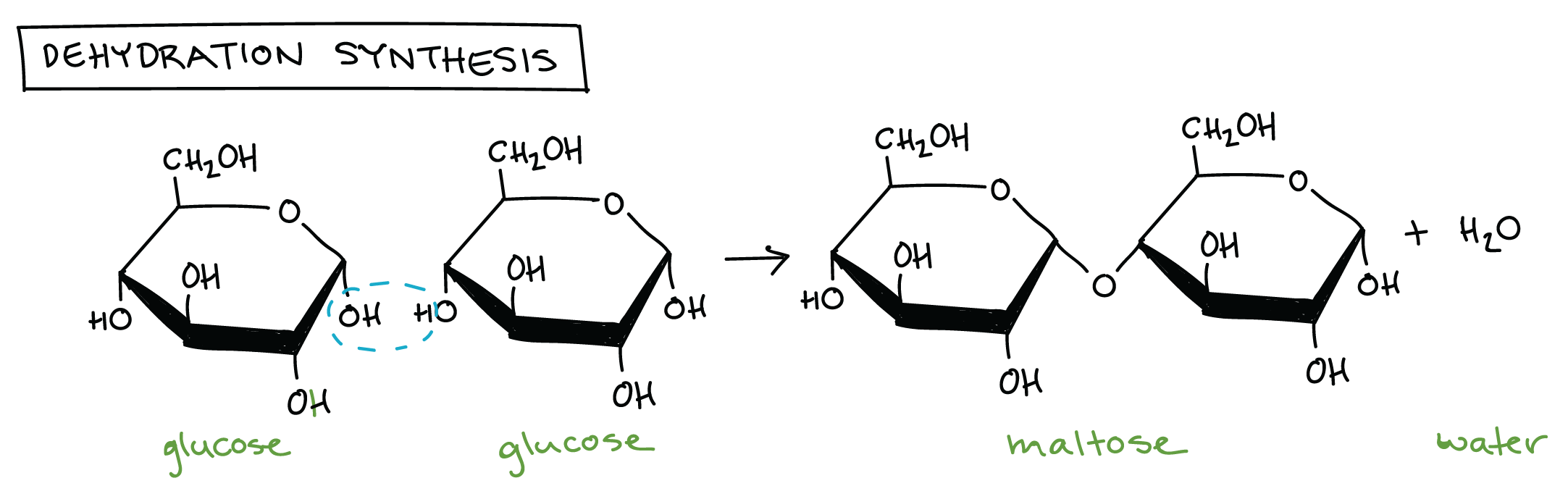
In the dehydration synthesis reaction above, two molecules of the sugar glucose (monomers) combine to form a single molecule of the sugar maltose. One of the glucose molecules loses an H, the other loses an OH group, and a water molecule is released as a new covalent bond forms between the two glucose molecules. As additional monomers join by the same process, the chain can get longer and longer and form a polymer.
Even though polymers are made out of repeating monomer units, there is lots of room for variety in their shape and composition. Carbohydrates, nucleic acids, and proteins can all contain multiple different types of monomers, and their composition and sequence is important to their function.