What are “Quantitative Evidence” questions? On the Reading and Writing section of the SAT, some questions will provide a graph or table that presents information about an unfamiliar topic. The question will then offer some context for that information and ask you to complete a sentence by effectively using data from the graph of table.
Example:
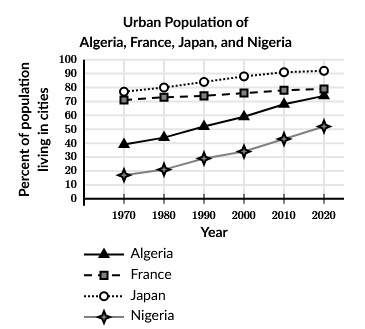
The share of the world’s population living in cities has increased dramatically since 1970, but this change has not been uniform. France and Japan, for example, were already heavily urbanized in 1970, with 70% or more of the population living in cities. The main contributors to the world’s urbanization since 1970 have been countries like Algeria, whose population went from ___
Which choice most effectively uses data from the graph to complete the assertion?
a. Less than 20% urban in 1970 to more than 50% urban in 2020. b. Less than 40% urban in 1970 to around 90% urban in 2020. c. Around 40% urban in 1970 to more than 70% urban in 2020. (Correct) d. Around 50% urban in 1970 to around 90% urban in 2020.
How should we think about quantitative evidence questions? The challenges of answering quantitative evidence questions can be split into three parts.
Understanding the Argument Every quantitative evidence question will provide more information than we need. One of the keys to successfully answering these questions is knowing what data to look for, so we can avoid being distracted by all the extra details and find the answer more quickly.
The way to do this is by carefully reading the prompt text. This paragraph will provide the context we need to understand the data in the graph or table. This paragraph will also outline the argument that our quantitative evidence must support.
This argument is the most important part of the question. Whichever data we use to complete the sentence must provide evidence in support of that argument. In other words: it tells us what to look for.
Reading the Data The data provided in a quantitative evidence question can be presented in a variety of forms. The question might include a bar graph, a line graph, a table, or any number of other formats that can be used to visually represent data. Luckily, you’ve almost certainly encounter all of these types of data visualizations in your math and science courses.
Remember, though: graphs and tables will include more data than you need, which will require you to sift through and read around for that extra information. If you’re working quickly, or looking back and forth between the question and the graph, you eyes can easily drift. Double check that you’re looking in the right place and at the right data.
Evaluating the Choices Quantitative evidence questions will offer two different types of incorrect choices alongside the correct answer.
-
False statements These choices are false according to the information in the graph or table. They misread or misrepresent data.
-
True statements These choices are true according to the information in the graph or table. They accurately represent data, but they fail to provide direct evidence for the argument being made.
False statements are easy to eliminate. You can simply compare the claim in the choice to the data in the graph. If these things disagree, you can eliminate that choice.
True statements, however, are trickier to handle. Instead of deciding if they’re true or false, you’ll need to decide if they support the argument made in the paragraph. This is why the first challenge of “understanding the argument” is so important.
Note: If a question includes false statements among the choices, then all incorrect choices for that question will be false.
How to approach quantitative evidence questions To solve a quantitative evidence questions, follow these steps:
-
Skin the graph You don’t need to dig into the graph or table yet, as you don’t know what data to look for. However, it can still be useful to familiarize yourself with what the graph or table contains. You can read the title, the labels, the units, and the key. Those should give you a good idea of what the graph contains without taking too much of your time.
-
Read the paragraph The text should be your main focus. It will tell you what data to look for.
Sometimes, like in our example question, the text will explicitly direct you to a specific piece of information: a certain time, place, or set of conditions that can be pinpointed within the graph or table. In these cases, you can simply identify the correct information in the graph or table and/or test the choices against the provided data.
Other times, the text will present a general argument, and you’ll need to select data that backs up that argument. In these cases, there may be multiple pieces of information that can potentially serve as evidence, so you won’t be able to just pull the correct data from the graph. The best thing to do here is to summarize the argument being made in your own words. Then you can test that summary against each of the choices to see which provides effective evidence.
- Validate the choices As we identified earlier, quantitative evidence choices can contain both true statements and false statements.
Read the choices and check them against the information in the graph. Are the choices true or false?
- If they’re false, eliminate the false choices
- If they’re true, proceed to step 4
- Find the best evidence Once you validated the choices, you should have eliminated any statements that are false according to the graph or table. This leaves you with choices that are true, but that may not provide effective evidence for the argument in the text.
Take your summary of the text and test it against each remaining choice. Only one choice will provide direct support for that argument. You can select that choice with confidence.
Use your Finger/Cursor When you’re looking at a graph or table that contains multiple data points, your eyes can easily drift. Placing your finger or your cursor directly on the information you’re looking for can help you avoid silly mistakes due to looking in the wrong place.
Check if the choices are true or false Usually, when one incorrect choice makes false statement, all the incorrect choices for that question will make false statements. And when on incorrect choice is true, all the incorrect choices will be true.
Determining this early can be helpful, as it changes the nature of your task. If the choices are false, you can easily eliminate your way to the correct answer. If the choices are true, you’ll need to think more deeply about the argument being made.