Plymouth Colony (sometimes Plimouth) was the first permanent English colony in New England from 1620 and the third permanent English colony in America, after Newfoundland and the Jamestown Colony. It was settled by the passengers on the Mayflower at a location that had previously been surveyed and named by Captain John Smith.
Early Settlement
The first group of Puritans to make their way across the Atlantic was a small contingent known as the Pilgrims. Unlike other Puritans, they insisted on a complete separation from the Church of England and had first migrated to the Dutch Republic seeking religious freedom.
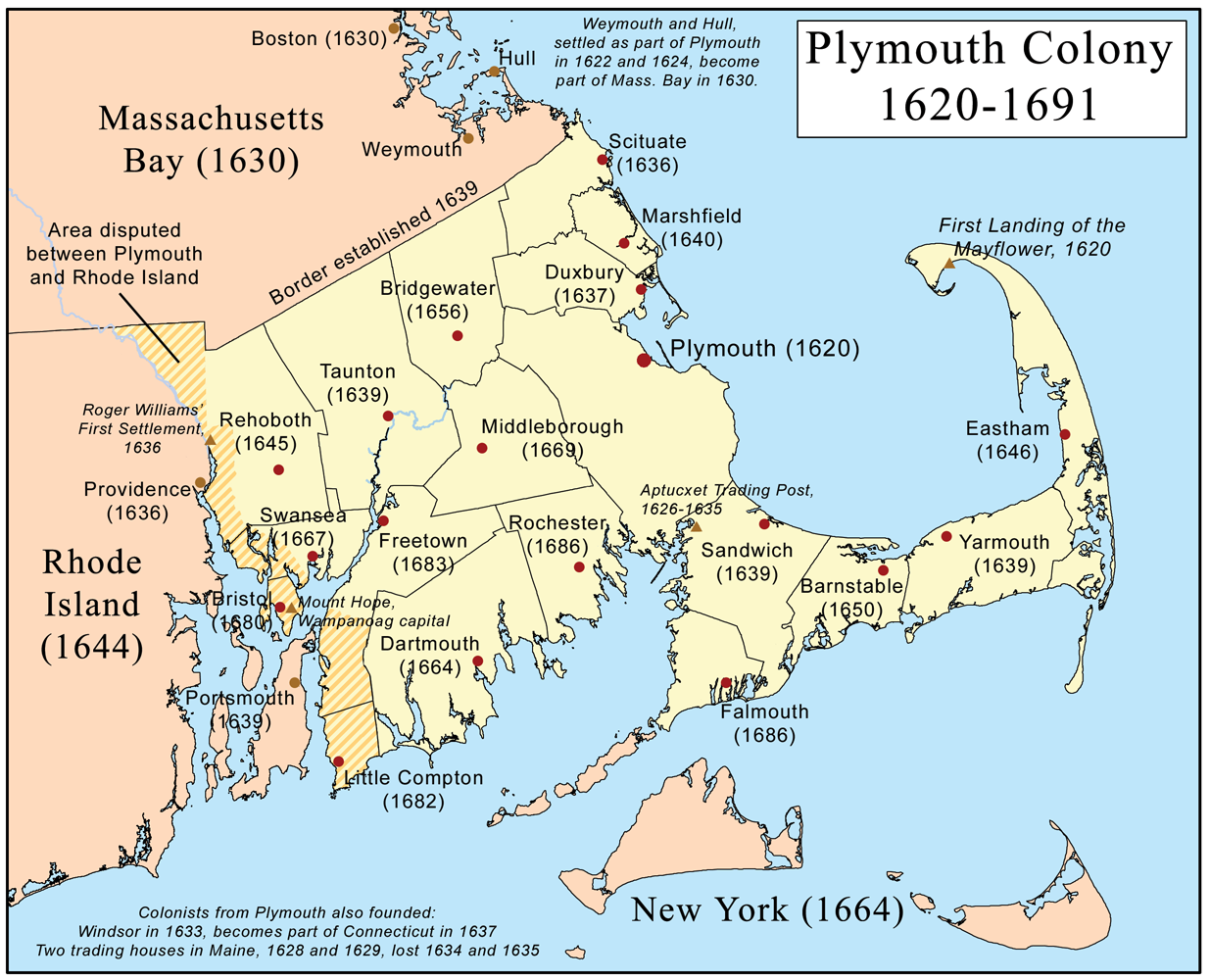
Although they found they could worship without hindrance there, they grew concerned that they were losing their Englishness as they saw their children begin to learn the Dutch language and adopt Dutch ways. In addition, the English Pilgrims—and others in Europe—feared another attack on the Dutch Republic by Catholic Spain. Because of this, in 1620 they moved on to found the Plymouth Colony in present-day Massachusetts.
The governor of Plymouth, William Bradford, was a Separatist—a proponent of complete separation from the English state church. Bradford and the other Pilgrim Separatists represented a major challenge to the prevailing vision of a unified English national church and empire. On board the Mayflower, which was bound for Virginia but landed on the tip of Cape Cod, Bradford and 40 other adult men signed the Mayflower Compact, which presented a religious—rather than an economic—rationale for colonization. The compact expressed a community ideal of working together.
When a larger exodus of Puritans established the Massachusetts Bay Colony in the 1630s, the Pilgrims at Plymouth welcomed them and the two colonies cooperated with each other.