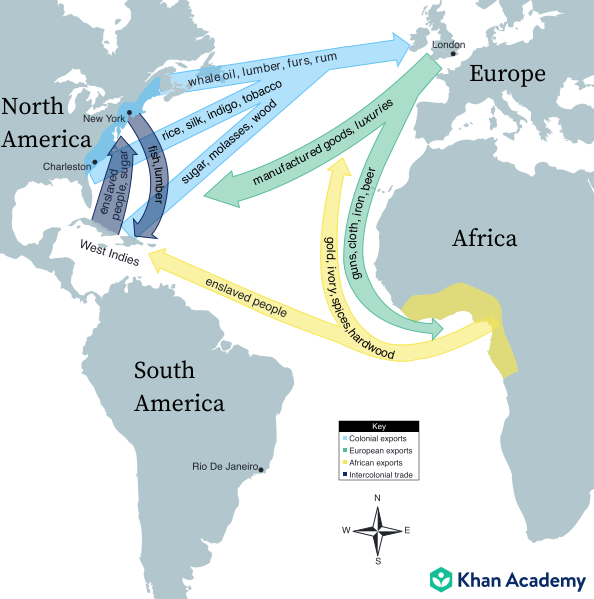
Mercantilism led to the emergence of triangular trade: a system of exchange in which Europe supplied Africa and the Americas with finished goods, the Americas supplied Europe and Africa with raw materials, and Africa supplied the Americas with enslaved laborers.
In theory, a ship could make its way from one continent to another laden with cargo that would be prized in the next port: buying enslaved laborers on the coast of Africa, sailing to Barbados to sell enslaved people and buy sugar, sailing to England to sell sugar and buy guns, and then sailing to the coast of Africa to sell guns and buy more enslaved people.
Although this generalization demonstrates how each continent supplied the others with the goods or labor they lacked, the reality was a bit more complex: few ships would have completed the full triangle, and ships might also make more than one stop in the colonies—to exchange food from New England and enslaved people from the sugar islands, for instance.
The Atlantic Slave Trade
The European slave trade began with Portugal’s exploration of the west coast of Africa in search of a sea trade route to the East. The East had bountiful new resources, like spices and silk, and the Portuguese were eager to acquire these goods without the laborious journey by land from Europe to Asia.
By 1444, the Portuguese brought enslaved people from Africa to work on the sugar plantations of the Madeira Islands, off the coast of modern Morocco. The slave trade then expanded across the Atlantic as European colonies demanded an ever-increasing number of workers for the extensive plantations growing the labor-intensive crops of tobacco, sugar, and eventually rice and cotton.
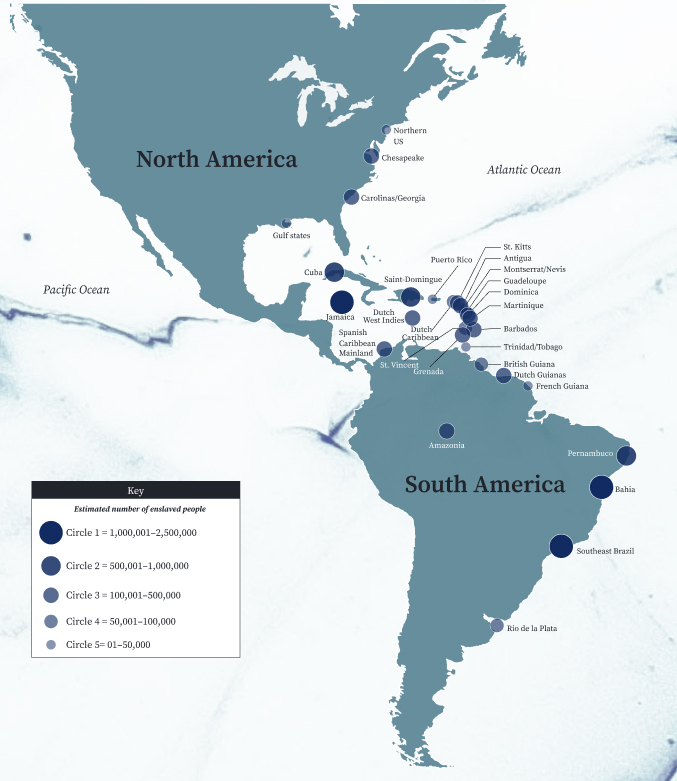
Soon, the Spanish, Dutch, and English all followed the Portuguese in transporting enslaved people across the Atlantic. The Trans-Atlantic Slave Trade Database estimates that 12.5 million Africans were sent through the Middle Passage—across the Atlantic—to work in the New World. Many Africans died on their way to the Americas, and those who did arrive often faced conditions worse than the slave ships. Soon, the Atlantic slave trade would contribute to enshrining a racial hierarchy into New World culture.