The founder effect is another extreme example of drift, one that occurs when a small group of individuals breaks off from a larger population to establish a colony. The new colony is isolated from the original population, and the founding individuals may not represent the full genetic diversity of the original population. That is, alleles in the founding population may be present at different frequencies than in the original population, and some alleles may be missing altogether. The founder effect is similar in concept to the bottleneck effect, but it occurs via a different mechanism.
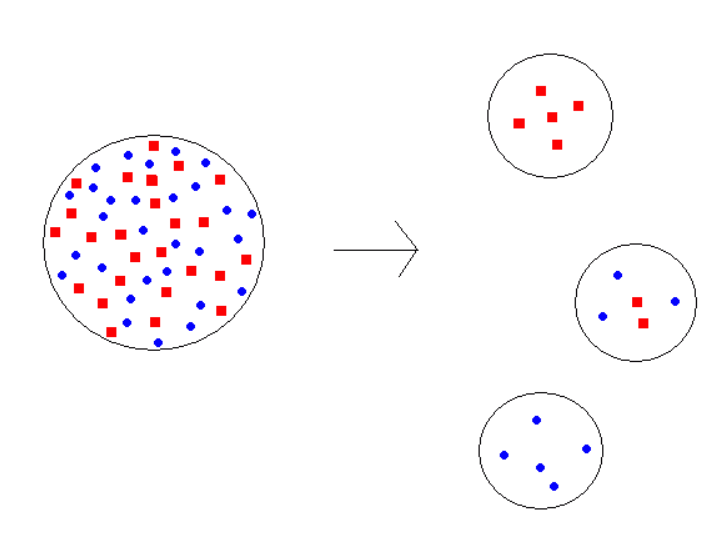
In the figure above, you can see a population made up of equal numbers of squares and circles (assuming an individual’s shape is determined by its alleles for a particular gene).
Random groups that depart to establish new colonies are likely to contain different frequencies of squares and circles than the original population. So, the allele frequencies in the colonies (small circles) may be different relative to the original population. Also, the small size of the new colonies means they will experience strong genetic drift for generations.