A polygenic trait is a characteristic, such as height or skin color, that is influenced by two or more genes. Many polygenic traits are also influenced by the environment and are called multifactorial.
Human features like height, eye color, and hair color come in lots of slightly different forms because they are controlled by many genes, each of which contribute some amount to the overall phenotype. For example, there are two major eye color genes, but at least 14 other genes that play roles in determining a person’s exact eye color.
We can use an example involving wheat kernels to see how several genes whose alleles “add up” to influence the same trait can produce a spectrum of phenotypes.
In this example, there are three genes that each make reddish pigment in wheat kernels, which we’ll call A, B, and C. Each comes in two alleles, one of which makes pigment (uppercase) and one of which does not (lowercase). These alleles have additive effects: the aa genotype would contribute no pigment, the Aa genotype would contribute some amount of pigment, and the AA genotype which would contribute more pigment ( twice as much as Aa). The same would hold true for the B and C genes.
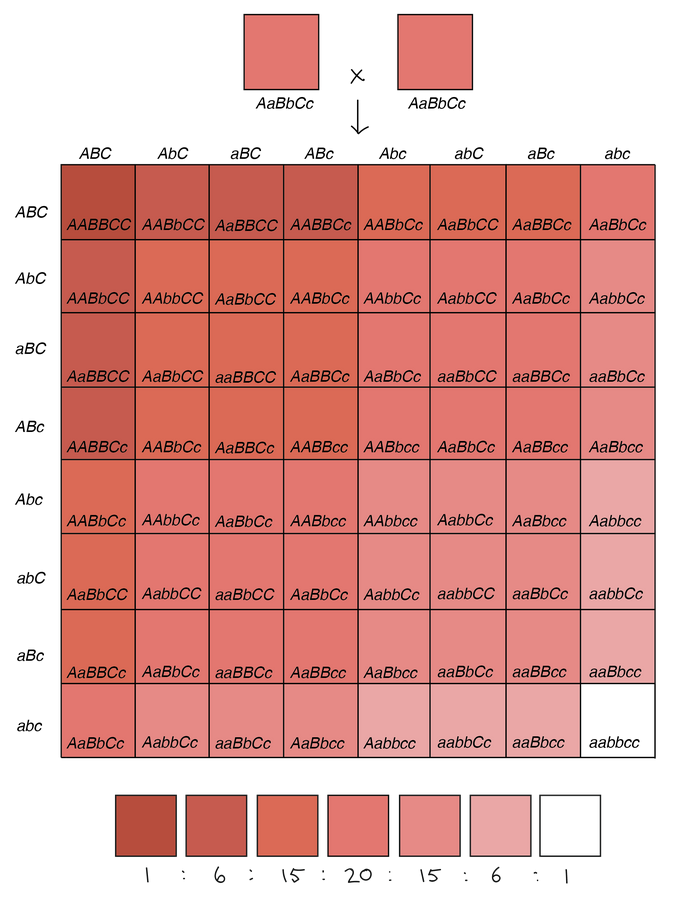
Imagine that two plants heterozygous for all three genes (AaBbCc) were crossed to one another. Each of the parent plants would have three alleles that made pigment, leading to pinkish kernels. Their offspring, however, would fall into seven color groups, ranging from no pigment whatsoever (aabbcc) and white kernels to lots of pigment (AABBCC) and dark red kernels. This is in fact what researchers have seen when crossing certain varieties of wheat.
This example shows how we can get a spectrum of slightly different phenotypes (something close to continuous variation) with just three genes. Increasing the number of genes would get even finer variations in color, or in another trait such as height.