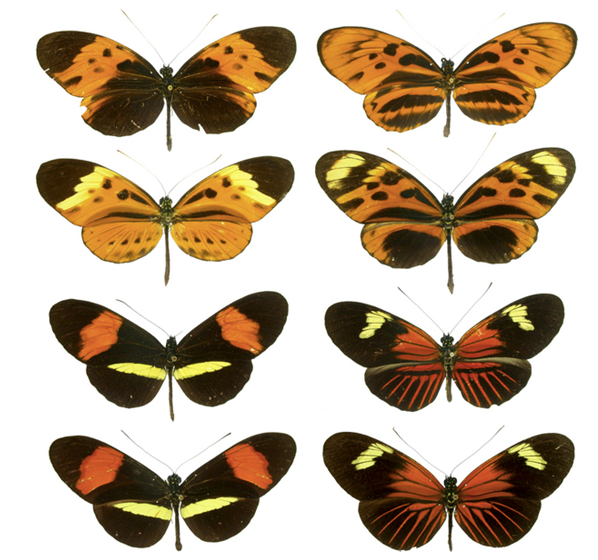
Müllerian mimicry is a natural phenomenon in which two or more well-defended species, often foul-tasting and sharing common predators, have come to mimic each other’s honest warning signals, to their mutual benefit. In Müllerian mimicry, multiple species share the same warning coloration, but all of them actually do have defenses. For example, the figure below shows pairs of foul-tasting butterflies that share similar coloration. Once a predator encounters either member of the pair and discovers its unpleasant taste, it is likely to avoid both species in the future. This similar appearance could have been evolutionarily favored because when members of the two species looked more similar, both would have tended to get eaten at lower rates—thanks to the protection provided by a predator learning to avoid either.