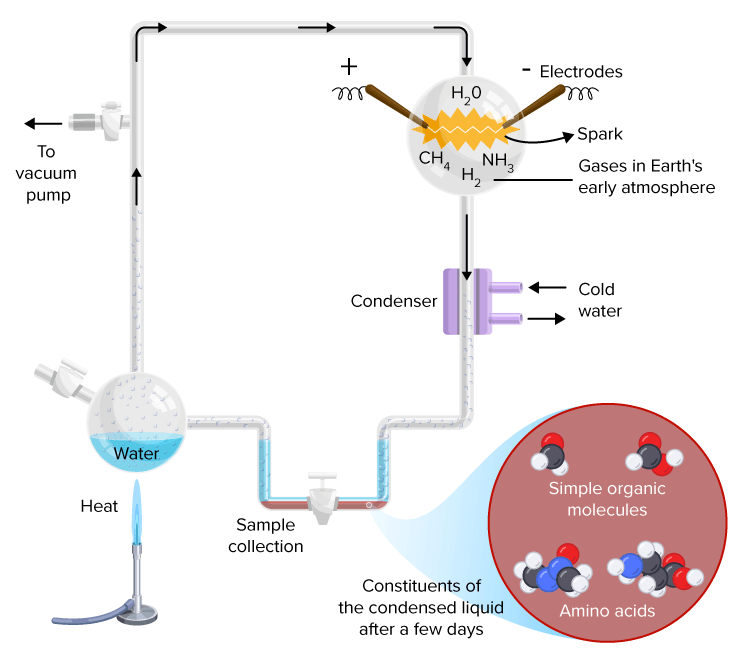
A Miller-Urey experiment attempts to explain the origins of life by replicated the conditions the first organism may have began in.
At the end of one week of continuous experiment, Miller and Urey observed organic compounds from originally inorganic compounds. attempts to explain the origins of life by replicated the conditions the first organism may have began in.
They showed that a spark igniting a mixture of gases resembling Earth’s primitive atmosphere could produce most of the building blocks for organic molecules of life – thus forming an “organic soup.” Their experiment showed that a mixture of gases, believed to be part of primitive Earth’s atmosphere, when subjected to sparks representing lightning, formed a mixture of monomers representing each of the four major groups of organic molecules. These gases included methane, ammonia, water, and hydrogen. Together, these gases contain carbon, hydrogen, nitrogen, and oxygen atoms, which are all components of organic compounds. Within a week of starting the experiment, several simple organic molecules had formed.
The experiment helped give credence to the primordial soup.