Polymers are broken down into monomers via hydrolysis reactions, in which a bond is broken, or lysed, by addition of a water molecule.
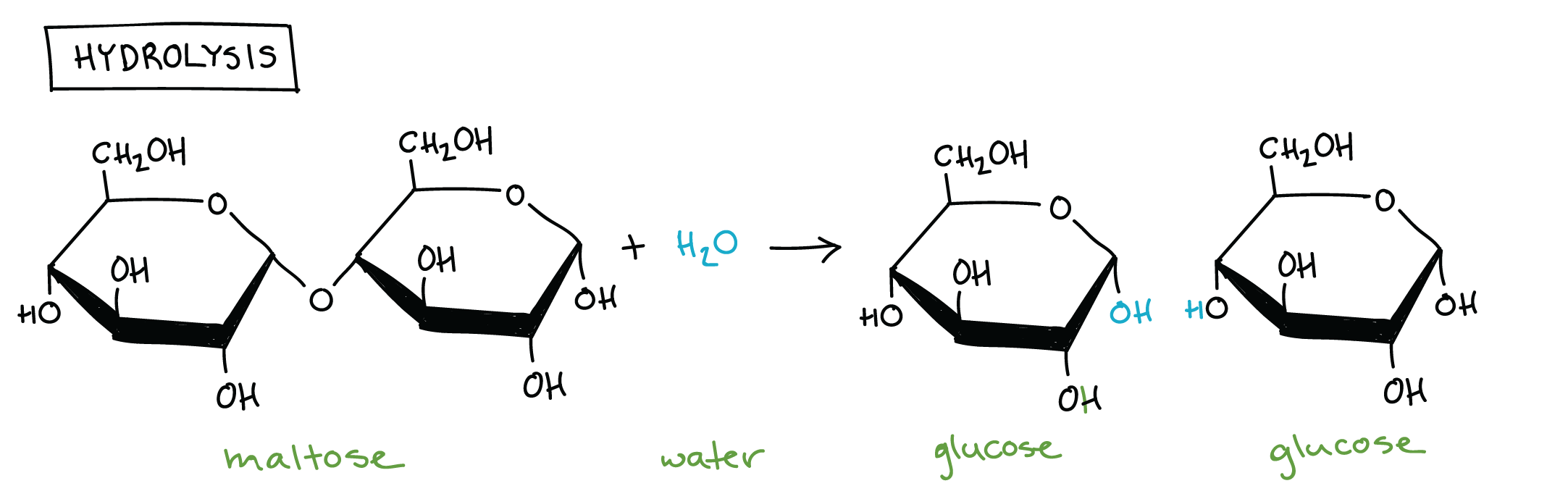
During a hydrolysis reaction, a molecule composed of multiple subunits is split in two: one of the new molecules gains a hydrogen atom, while the other gains a hydroxyl (-OH) group, both of which are donated by water. This is the reverse of a dehydration synthesis reaction, and it releases a monomer that can be used in building a new polymer. For example, in the hydrolysis reaction below, a water molecule splits maltose to release two glucose monomers. This reaction is the reverse of the dehydration synthesis reaction shown above.
Dehydration synthesis reactions build molecules up and generally require energy, while hydrolysis reactions break molecules down and generally release energy. Carbohydrates, proteins, and nucleic acids are built up and broken down via these types of reactions, although the monomers involved are different in each case.
In the body, enzymes catalyze, or speed up, both the dehydration synthesis and hydrolysis reactions. Enzymes involved in breaking bonds are often given names that end with -ase: for instance, the maltase enzyme breaks down maltose, lipases break down lipids, and peptidases break down proteins.