A fat molecule is a type of lipid and consists of two kinds of parts: a glycerol backbone and three fatty acid tails. Glycerol is a small organic molecule with three hydroxyl (OH) groups, while a fatty acid consists of a long hydrocarbon chain attached to a carboxyl group. A typical fatty acid contains 12–18 carbons, though some may have as few as 4 or as many as 36.
To make a fat molecule, the hydroxyl groups on the glycerol backbone react with the carboxyl groups of fatty acids in a dehydration synthesis reaction. This yields a fat molecule with three fatty acid tails bound to the glycerol backbone via ester linkages (linkages containing an oxygen atom next to a carbonyl, or C=O, group). Triglycerides may contain three identical fatty acid tails, or three different fatty acid tails (with different lengths or patterns of double bonds).
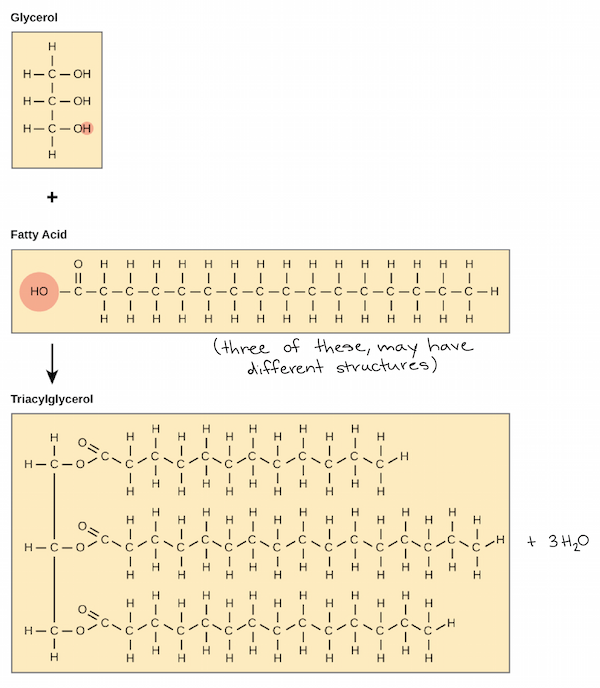
Fat molecules are also called triacylglycerols, or, in bloodwork done by your doctor, triglycerides. In the human body, triglycerides are primarily stored in specialized fat cells, called adipocytes, which make up a tissue known as adipose tissue. While many fatty acids are found in fat molecules, some are also free in the body, and they are considered a type of lipid in their own right.