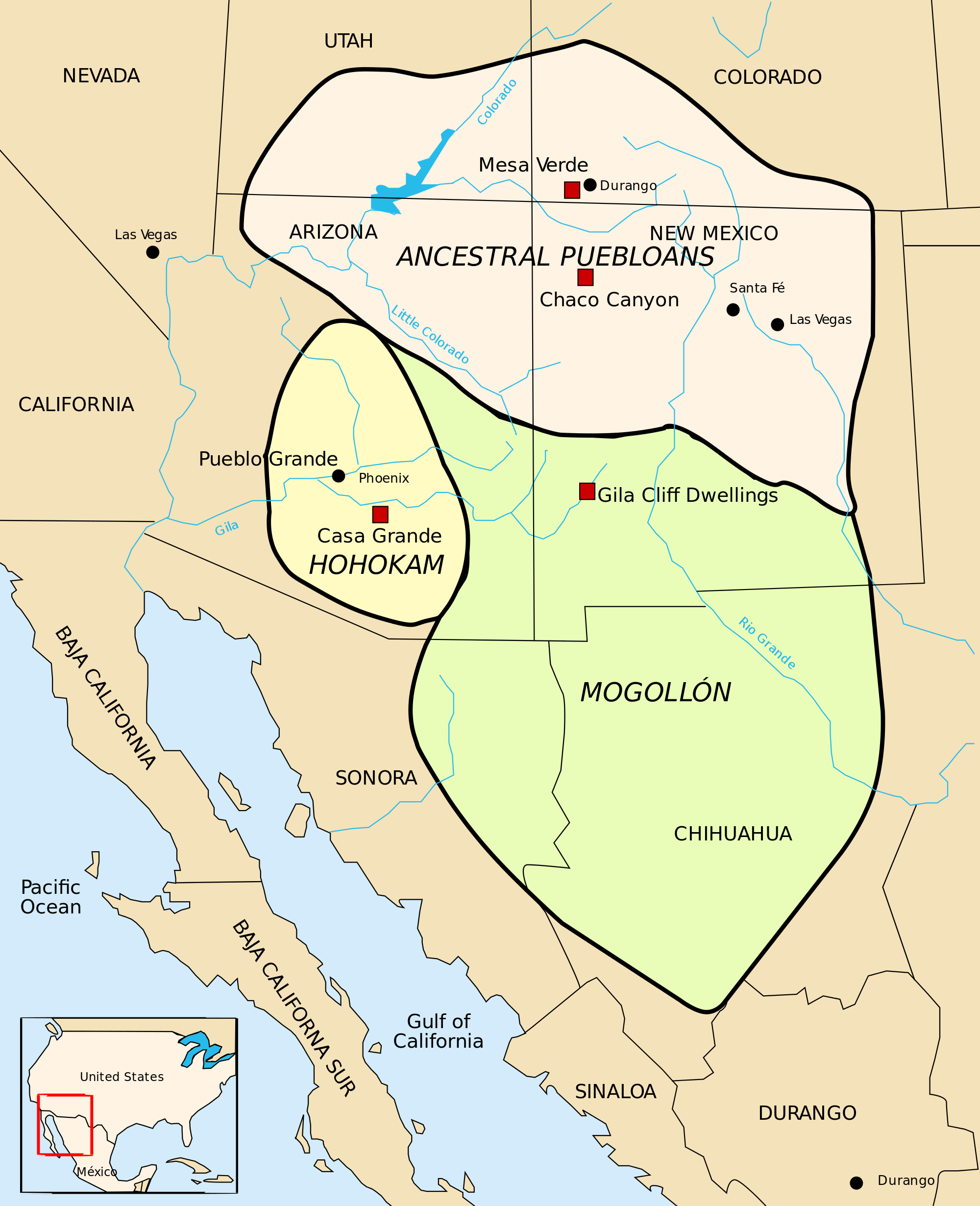
The Southwest region, expanding through present-day Arizona and New Mexico and into Colorado, Texas, Utah, and Mexico, was home to a variety of indigenous groups and cultural practices pre-colonization. In this region dwelled several groups we collectively call the Pueblo. The Spanish first gave them this name, which means “town” or “village,” because they lived in towns or villages of permanent stone-and-mud buildings with thatched roofs. The three main groups of the Pueblo people were the Mogollon, Hohokam, and Anasazi.
Anasazis, sometimes called the Ancestral Pueblos, resided in the Four Corners region (where the states of Colorado, Utah, New Mexico, and Arizona meet today); the Mogollon lived mostly in southwestern New Mexico; the Hohokam dominated the desert of southern Arizona.
Historians estimate that these three groups reigned over the region from approximately 200-1500 CE, and either dissolved or evolved into the Pueblos, whom the Spanish encountered during colonization and who still reside in modern New Mexico. They have also transformed into the Zuni and Hopi tribes. The Apache and Navajo tribes arrived in the Pueblo region around 1200 CE from the Pacific Northwest and remained distinct from the Pueblo people living in the region.
Introduction of Agriculture
Corn, the first crop the Ancestral Pueblos cultivated, permeates many creation stories of the Pueblo people. The Ancestral Pueblos regarded the harvest of corn not only as a nutritional necessity but as a spiritual gift. Although agriculture seemed to represent the society’s advancement, the Ancestral Pueblos had a much healthier diet when they hunted and gathered, as opposed to the limited diversity in a diet dominated by corn.
In the arid climate of the Southwest, Ancestral Pueblos developed complex irrigation systems, which maintained crops even in the hot sun. By 800 CE, Hohokams had created one of the largest irrigation systems to date, stretching through most of what we call Arizona today. This new irrigation system allowed the Pueblos to begin planting beans and squash in addition to corn.
Social Organization
Agriculture dictated the way the Ancestral Pueblo people lived. With surplus food and stability, they became more sedentary, living in stone and adobe houses. Equivalent to massive present-day apartment complexes, these buildings had multiple stories, each with multiple rooms. The Ancestral Pueblos, regarded as highly developed for their time, tended to live in larger towns with thousands of people and intricate dwellings.
Religious Practices
These southwestern peoples believed that farming was a more reliable way to ensure their society’s sustenance than hunting and gathering. But that hypothesis proved false in the face of natural disaster. A persistent drought, lasting from about 1130-1180 CE, decimated Anasazis’ crops, while a major flood in 1358 destroyed the Hohokam irrigation system.
These disasters led the Ancestral Pueblos to hold spiritual ceremonies, praying to their gods for a bountiful harvest and good weather. They would pray to natural entities, like plants and animals, for agricultural, hunting, and personal success. These religious ceremonies brought together lots of people to create larger religious communities than social units like the family.
Legacy
Ultimately, most of the Ancestral Pueblos fled the area, probably due to drought. The Spanish encountered a hodgepodge of remaining descendants of the Ancestral Pueblos in the mid-1550s, whom they named the Pueblos.