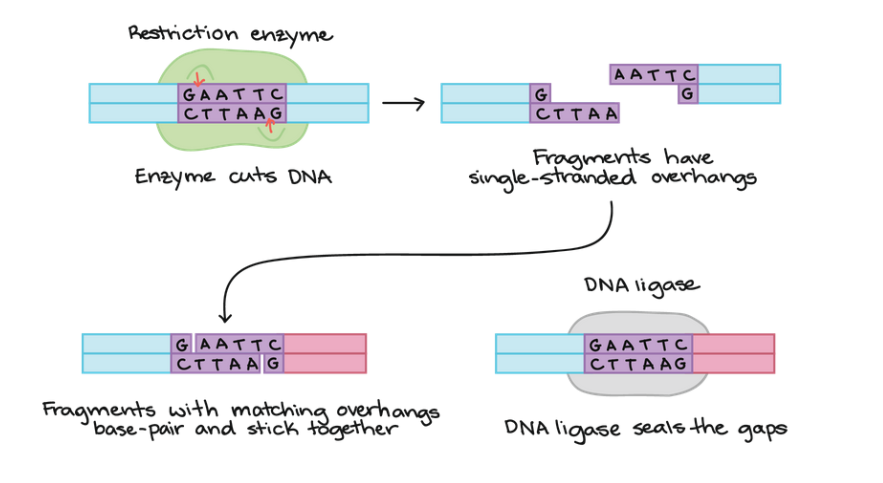
A restriction enzyme is a protein isolated from bacteria that cleaves DNA sequences at sequence-specific sites, producing DNA fragments with a known sequence at each end. The use of restriction enzymes is critical to certain laboratory methods, including recombinant DNA technology and genetic engineering.
Many restriction enzymes produce cut ends with short, sing-stranded overhangs. If two molecules have matching overhangs, they can base-pair and stick together. However, they won’t combine to form an unbroken DNA molecule until they are joined by DNA ligase, which seals gaps in the DNA backbone.