Key Points
- Biotechnology is the use of an organism, or a component of an organism or other biological systems, to make a product or process.
- Many forms of modern biotechnology rely on DNA technology.
- DNA technology is the sequencing, analysis, and cutting-and-pasting of DNA.
- Common forms of DNA technology include DNA sequencing, polymerase chain reaction, DNA cloning, and gel electrophoresis.
- Biotechnology inventions can raise new practical concerns and ethical questions that must be addressed with informed input from all of society.
What is Biotechnology Biotechnology is the use of an organism, or a component of an organism or other biological system, to make a product or process for a specific use.
This can include both cutting-edge laboratory techniques and traditional agricultural and culinary techniques that have been practiced for hundreds of years. Some examples of biotechnology are:
-
Beer brewing. In beer brewing, tiny fungi (yeasts) are introduced into a solution of malted barely sugar, which they busily metabolize through a process called fermentation. The byproduct of the fermentation is the alcohol that’s found in beer. An organism - the yeast - is being used to make a product for human consumption.
-
Penicillin. The antibiotic penicillin is generated in certain molds. To make small amounts of penicillin, researchers grow up to 500 liters of “mold juice” a week. An organism - the mold - is being used to make a product for human use.
-
Gene therapy. Gene therapy is an emerging technique used to treat genetic disorders that are caused by a nonfunctional gene. It works by delivering the “missing” gene’s DNA to the cells of the body. For instance, in the genetic disorder cystic fibrosis, people lack function of a gene for a chloride channel produced in the lungs. In a recent gene therapy clinical trial, a copy of the functional gene was inserted into a circular DNA molecule called a plasmid and delivered to patients’ lung cells in spheres of membrane (in the form of a spray). In this example, biological components from different sources (a gene from humans, a plasmid originally from bacteria) were combined to make a new product that helped preserve lung function in cystic fibrosis patients.
DNA Technology Many examples of modern biotechnology depend on the ability to analyze, manipulate, and cut and paste pieces of DNA. Approaches for the sequencing and manipulation of DNA are sometimes referred to as DNA technology. For example, for the cystic fibrosis gene therapy trail, researches used DNA manipulation techniques to insert the chloride channel gene into a piece of carrier DNA (a vector) that allowed it to be expressed in human lung cells.
DNA technology is important to both basic and applied (practical) biology. For instance, a technique used to make many copies of a DNA sequence, called polymerase chain reaction (PCR), is used in many medical diagnostic tests and forensics applications as well as in basic laboratory research.
Examples of DNA Technologies
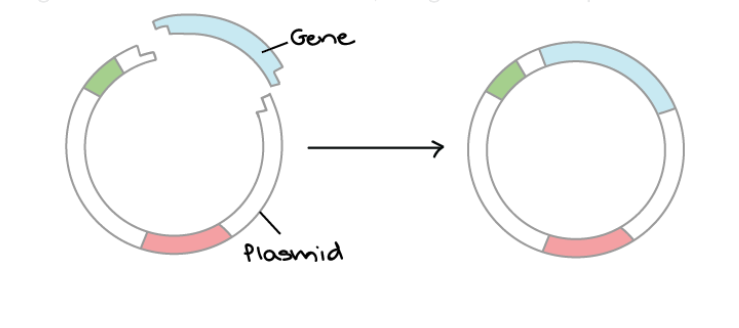
- DNA cloning. In DNA cloning, researchers “clone” a DNA fragment of interest, such as a gene. In many cases, DNA cloning involves inserting a target gene into a circular DNA molecule called a plasmid. The plasmid can be replicated in bacteria, making many copies of the gene of interest. In some cases, the gene is also expressed in the bacteria, making a protein.
-
Polymerase chain reaction (PCR). Polymerase chain reaction is another widely used DNA manipulation technique, one with applications in almost every area of modern biology. PCR reactions produce many copies of a target DNA sequence starting from a piece of template DNA. This technique can be used to make many copies of DNA that is present in trace amounts.
-
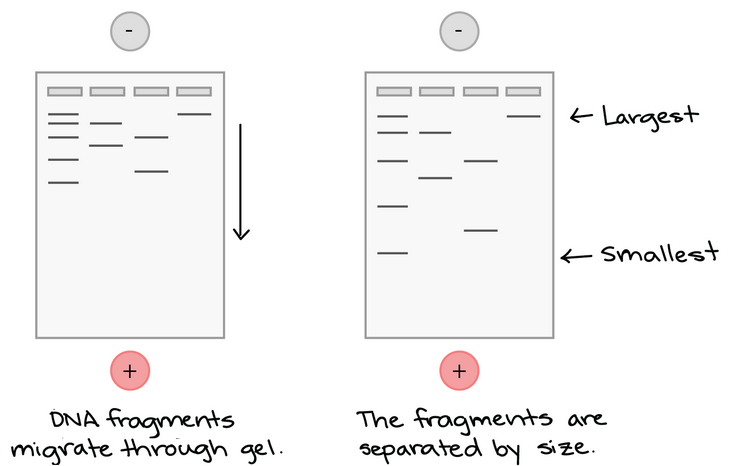
Gel electrophoresis. Gel electrophoresis is a technique used to visualize DNA fragments. For instance, researchers can analyze the results of a PCR reaction by examining the DNA fragments it produces on a gel. Gel electrophoresis separates DNA fragments based on their size, and the fragments are stained with a dye so the researcher can see them.
- DNA sequencing. DNA sequencing involves determining the sequences of nucleotide bases in a DNA molecule. In some cases, just one piece of DNA is sequenced at a time, while in other cases, a large collection of DNA fragments (such as those from an entire genome) may be sequenced as a group.