Boveri-Sutton Chromosome Theory Chromosomes are what contains the inheritable factors since chromosomes behave similar to the inheritable factors. Chromosomes code for multiple inheritable factors that segregate and independently assort.
Genes are found at specific locations on chromosomes, and that the behavior of chromosomes during meiosis can explain Mende’s laws of inheritance.
Observations that support the chromosome theory of inheritance include:
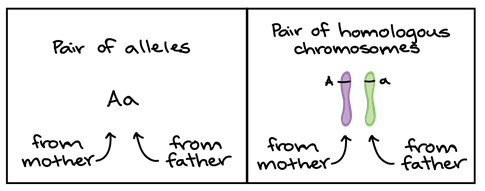
Chromosomes, like Mende’s genes, come in homologous pairs in an organism. For both genes and chromosomes, one member of the pair comes from the mother and other from the father.
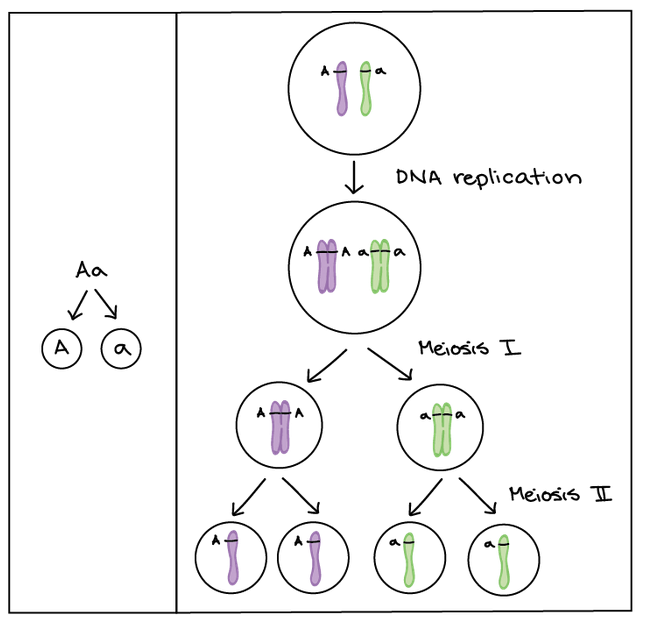
The members of a homologous pair separate in meiosis, so each sperm or egg receives just one member. This process mirrors segregation of alleles into gametes in Mende’s Law of Segregation.
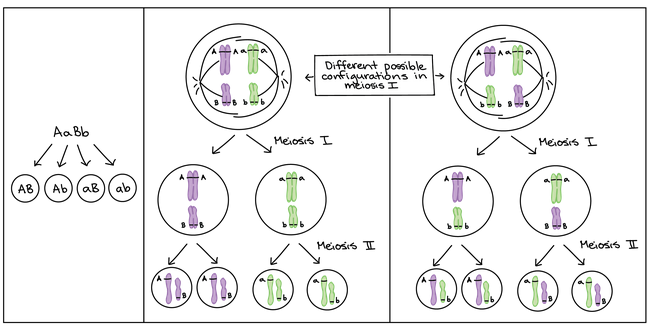
The members of different chromosomes pairs are sorted into gametes independently of one another in meiosis, just like the alleles of different genes in Mende’s Law of Independent Assortment.
Aneuploidy and Chromosomal Rearrangements Most of your cells contain 46 chromosomes, rod-like structures made of DNA and protein, that come in 23 matched pairs. These chromosomes carry tens of thousands of genes, which tell your body how to develop and which keep it functioning from moment to moment during your lifetime.
If a chromosome pair loses or gains a member, or even part of a member, the delicate balance of the human body may be disrupted.
Aneuploidy: Extra or Missing Chromosomes Changes in a cell’s genetic material are called mutations. In one form of mutation, cells may end up with an extra or missing chromosome.
Each species has a characteristic chromosome number, such as 46 chromosomes for a typical human body cell. In organisms with two full chromosomes sets, this number is given the name 2n. When an organism or cell contains 2n chromosomes (or some other multiple of n), it is said to be euploid, meaning that it contains chromosomes correctly organized into complete sets.
An aneuploid is missing one or more chromosomes, unlike a euploid. For instance, human somatic cells with chromosome numbers of (2n - 1) = 45 or (2n + 1) = 47 are aneuploid. Similarly, a normal human egg or sperm has just one set of chromosomes (n = 23). An egg or sperm with (n - 1) = 22 or (n + 1) = 24 chromosomes is considered to be aneuploid.
Two common types of aneuploidy have their own special names:
- Monosomy is when an organism has only one copy of a chromosome that should be present in two copies (2n - 1).
- Trisomy is when an organism has a third copy of a chromosome that should be present in two copies (2n + 1).
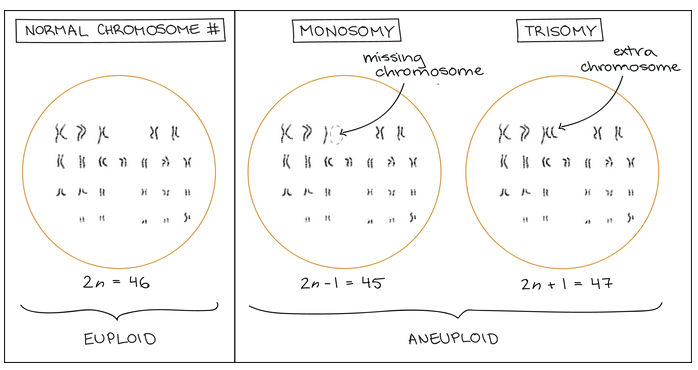
Aneuploidy also contains cases where as cell has larger numbers or extra or missing chromosomes, as in (2n - 2), (2n +3), etc. However, if there is an entire extra or missing chromosome set (e.g., 3n), this is not formally considered to be aneuploidy, even though it may still be bad for the cell or organism. Cells or organisms with more than two complete sets are said to be polyploid.
Nondisjunction of Chromosomes Disorders of chromosomes number are caused by nondisjunction, which occurs when pairs of homologous chromosomes or sister chromatids fail to separate during meiosis I or meiosis II (or during mitosis)
The diagram below shows how nondisjunction can take place during meiosis I if homologous chromosomes don’t separate, and how this can lead to the production of aneuploid gametes.
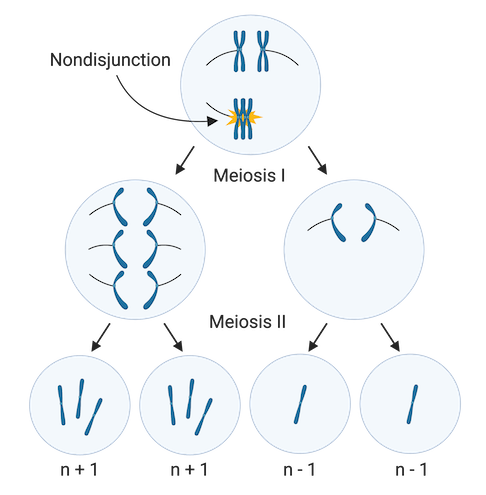
Nondisjunction can also happen in meiosis II, with sister chromatids (instead of homologous chromosomes) failing to separate, Again, some gametes contain extra or missing chromosomes.
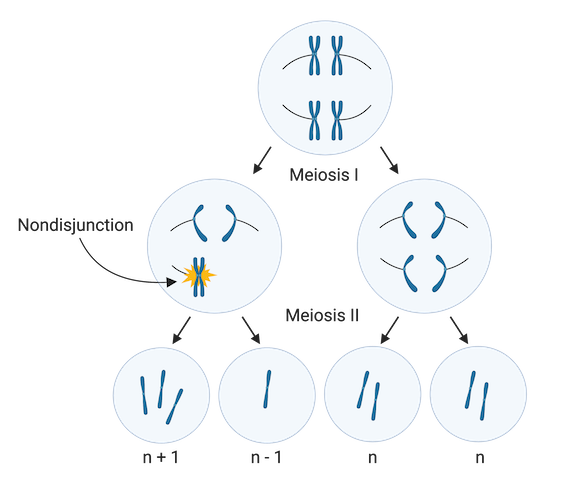
Nondisjunction can also happen during mitosis. In humans, chromosomes changes due to nondisjunction during mitosis in body cells will not be passed on to children (because these cells don’t make sperm and eggs). But mitotic nondisjunction can cause other problems: cancer cells often have abnormal chromosome numbers.
When an aneuploid sperm or egg combines with a normal sperm or egg in fertilization, it makes a zygote which is also aneuploid. For instance, if a sperm cell with one extra chromosome (n + 1) combines with a normal egg cell (n), the resulting zygote, or one-celled embryo, will have a chromosome number of 2n + 1.
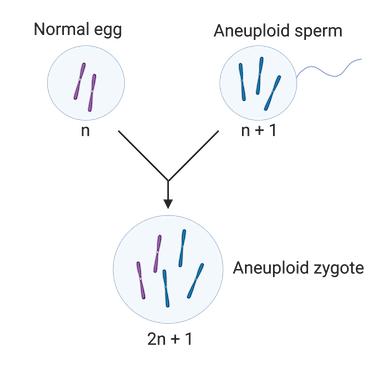
Genetic Disorders Cause by Aneuploidy Human embryos that are missing a copy of any autosome fail to develop at birth. In other words, human autosomal monosomies are always lethal. That’s because the embryos have too low a “dosage” of the proteins and other gene products that are encoded by genes on the missing chromosome.
Most autosomal trisomies also prevent an embryo from developing to birth. However, an extra copy of some of the smaller chromosomes (13, 15, 18, 21, or 22) can allow the affected individual to survive for a short period past birth, or, in some cases, for many years. When an extra chromosome is present, it can cause problems in development due to an imbalance between the gene products from the duplicated chromosome and those from other chromosomes. A karyotype can show mutations in the amount of chromosomes.
Human genetic disorders can also be caused by aneuploidies involving sex chromosomes. These aneuploidies are better-tolerated than autosomal ones because human cells have the ability to shut down an extra X chromosome in a process called X-inactivation.
Chromosomal Rearrangements In another class of large-scale mutations, big chunks of chromosomes (but not entire chromosomes) are affected. Such changes are called chromosomal rearrangements. They include:
- A duplication, where part of a chromosome is copied.
- A deletion, where part of a chromsome is removed.
- An inversion, where chromosomal region is flipped around so that it points in the opposite direction.
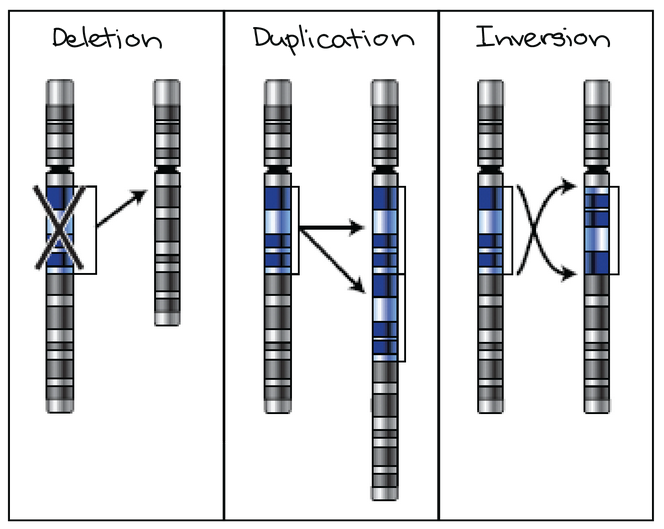
- A translocation, where a piece of one chromosome gets attached to another chromosome. A reciprocal translocation involves two chromosomes swapping segments; a non-reciprocal translocation means that a chunk of one chromosome moves to another.
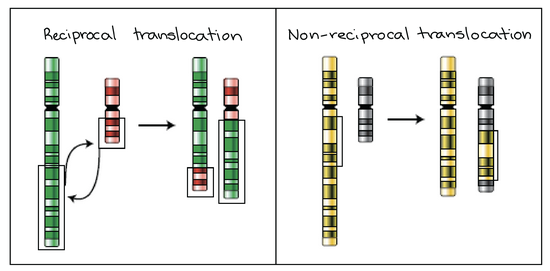
In some cases, a chromosomal rearrangement causes symptoms similar to the loss or gain of an entire chromosome. For instance, Down Syndrome is usually caused by a third copy of chromosome 21, but it can also occur when a large piece of chromosome 21 moves to another chromosome (and is passed on to offspring along with a regular chromosome 21) . In other cases, rearrangements cause unique disorders, ones that are not associated with aneuploidy.
Sexual Reproduction Natural selection relies on genetic variation within a species. Mutations alone aren’t sufficient for creating diversity; sexual reproduction plays a crucial role as well. By combining genetic material from two parents, offspring inherit a unique mix of traits, resulting in vast potential for variation. This process allows for more efficient adaptation and survival, making sexual reproduction a widespread biological strategy.