Plasmodesmata (singular: plasmodesma) are microscopic channels which traverse the cell walls of plant cells and some algal cells, enabling transport and communication between them. Unlike animal cells, almost every plant cell is surrounded by a polysaccharide cell wall. Although cell walls are permeable to small soluble proteins and other solutes, plasmodesmata enable direct, regulated, transport of substances between cells. They are holes that allow direct cytoplasmic exchange between two cells.
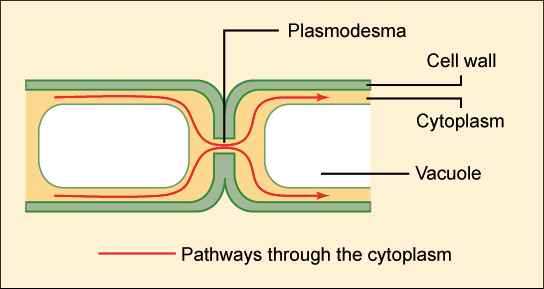
Plasmodesmata are lined with plasma membrane that is continuous with the membranes of the two cells. Each plasmodesma has a thread of cytoplasm extending through it, containing an even thinner thread of endoplasmic reticulum (not shown in the diagram above).
Molecules below a certain size (the size exclusion limit) move freely through the plasmodesmal channel by passive diffusion. The size exclusion limit varies among plants, and even among cell types within a plant. Plasmodesmata may selectively dilate (expand) to allow the passage of certain large molecules, such as proteins, although this process is poorly understood.