Disorders of chromosomes number are caused by nondisjunction, which occurs when pairs of homologous chromosomes or sister chromatids fail to separate during meiosis I or meiosis II (or during mitosis)
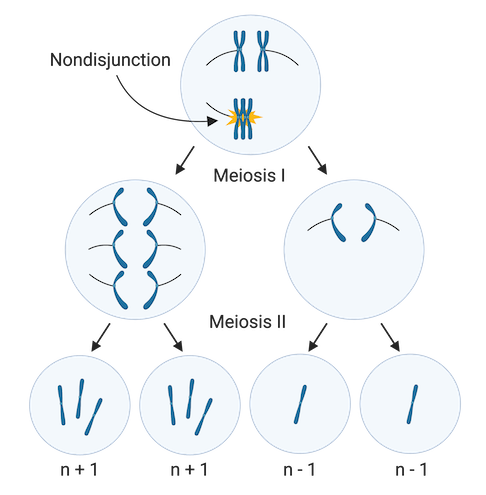
The diagram below shows how nondisjunction can take place during meiosis I if homologous chromosomes don’t separate, and how this can lead to the production of aneuploid gametes.
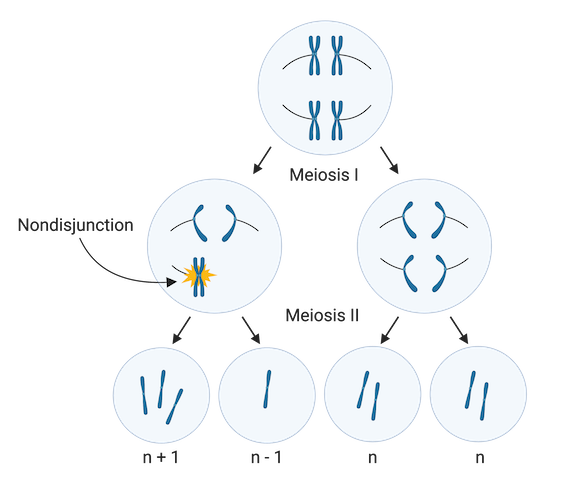
Nondisjunction can also happen in meiosis II, with sister chromatids (instead of homologous chromosomes) failing to separate, Again, some gametes contain extra or missing chromosomes.
Nondisjunction can also happen during mitosis. In humans, chromosomes changes due to nondisjunction during mitosis in body cells will not be passed on to children (because these cells don’t make sperm and eggs). But mitotic nondisjunction can cause other problems: cancer cells often have abnormal chromosome numbers.
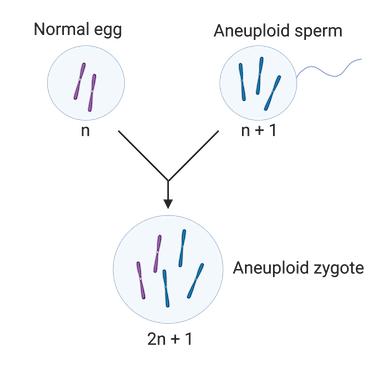
When an aneuploid sperm or egg combines with a normal sperm or egg in fertilization, it makes a zygote which is also aneuploid. For instance, if a sperm cell with one extra chromosome (n + 1) combines with a normal egg cell (n), the resulting zygote, or one-celled embryo, will have a chromosome number of 2n + 1.