The purpose of splicing is to remove the introns from mRNA transcript. The purpose of splicing is to remove the introns from the mRNA transcript. Introns are sequences of RNA that don’t contain any information about how to construct a protein.
Introns are snipped out of an mRNA transcript by a complex of enzymes called a spliceosome. A spliceosome locates introns, cuts them out, and then fuses the remaining parts of the mRNA transcript back together. The parts of the mRNA transcript that aren’t spliced out by the spliceosome are called exons. In contrast to introns, exons are the part of an mRNA transcript that actually contain assembly instructions for a protein. Many call the mRNA transcript that still contains introns pre-mRNA, and the intron-free transcript that the spliceosome produces primary mRNA (also called “mature mRNA” by some authors).
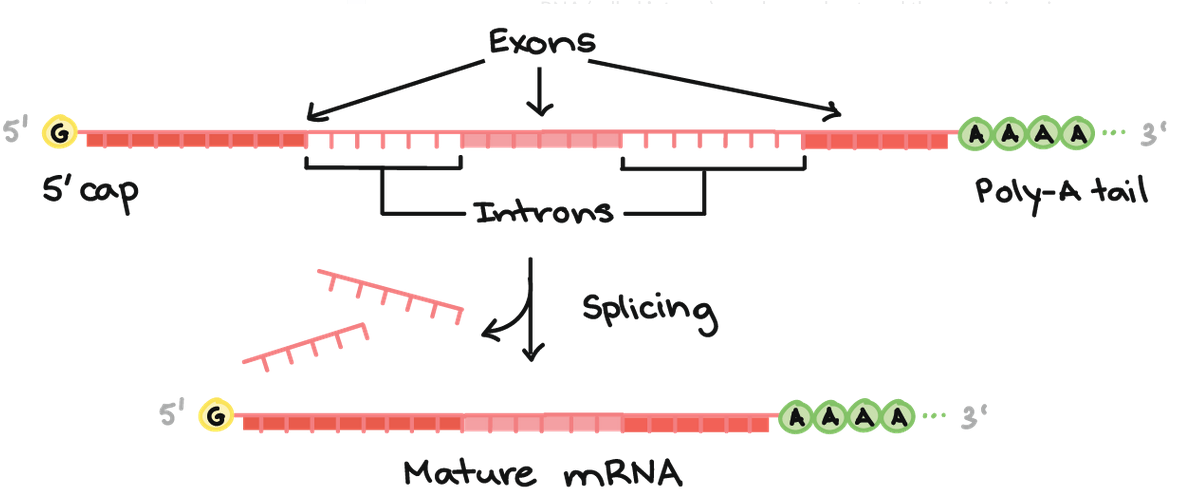
End modifications increase the stability of the mRNA, while splicing gives the mRNA its correct sequence. (If the introns are not removed, they’ll be translated along the exons, producing a “gibberish” polypeptide).
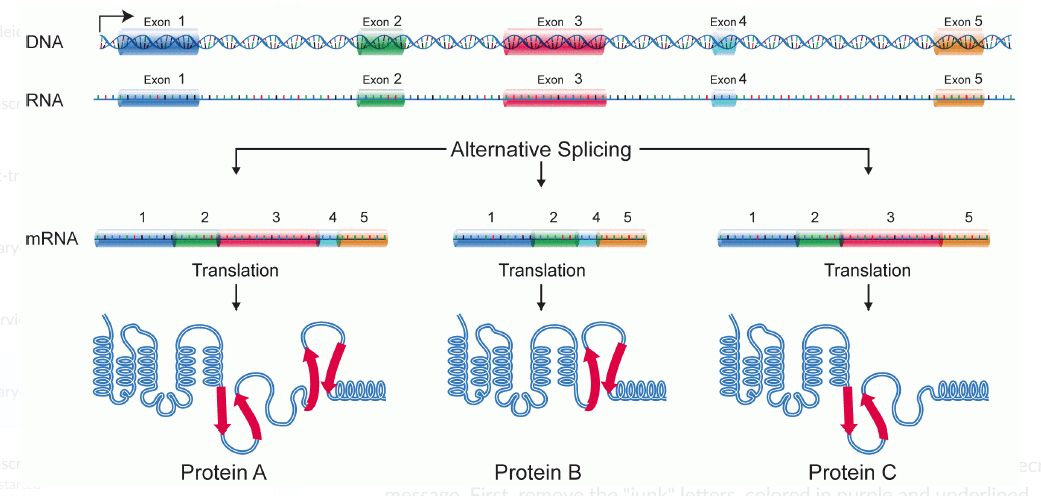
Alternative Splicing Splicing does allow for a process called alternative splicing, in which more than one mRNA can be made from the same gene. Through alternative splicing, we (and other eukaryotes) can sneakily encode more different proteins than we have genes in our DNA.
In alternative splicing, one pre-mRNA may be spliced in either of two (or sometimes many more than two!) different ways. For example, in the diagram below, the same pre-mRNA can be spliced in three different ways, depending on which exons are kept. This results in three different mature mRNAs, each of which translates into a protein with a different structure.