Mendel’s work suggested that just two alleles existed for each gene. Although individual humans (and all diploid organisms) can only have two alleles for a given gene, multiple alleles may exist in a population level, and different individuals in the population may have different pairs of these alleles.
As an example, let’s consider a gene that specifies coat color in rabbits, called the gene. The gene comes in four common alleles: , , , and :
- A rabbit has black or brown fur.
- A rabbit has chinchilla (grayish fur) coloration.
- A rabbit Himalayan (color-point) patterning, with a white body and dark ears, face, feet, and tail.
- A rabbit is albino, with a pure white coat.
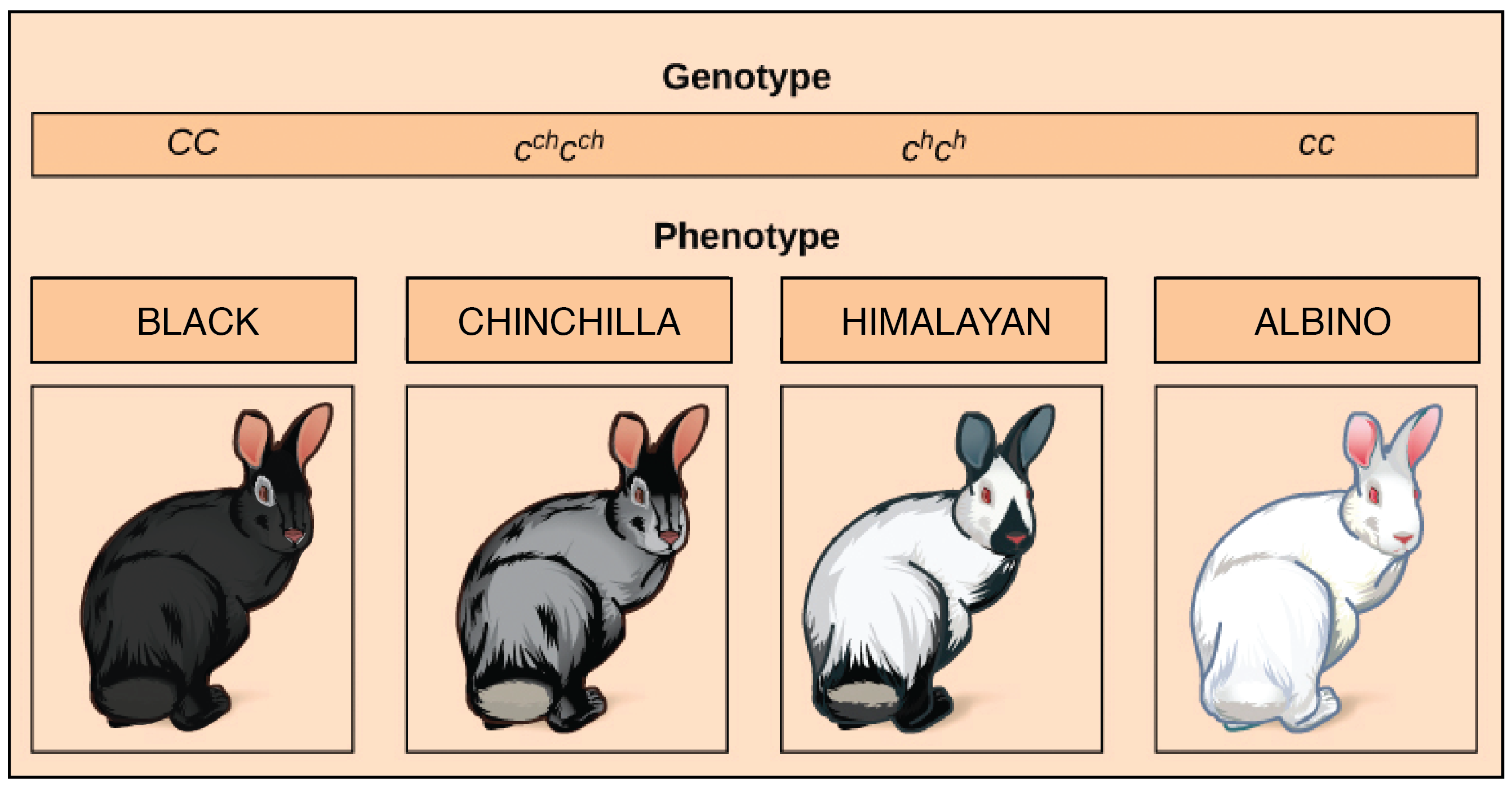
Multiple alleles makes for many possible dominance relationships. In this case, the black allele is completely dominant to all the others; the chinchilla allele is incompletely dominant to the Himalayan and albino alleles; and the Himalayan allele is completely dominant to the albino allele.