The Golgi apparatus, also known as the Golgi complex, Golgi body, or simply the Golgi, is an organelle found in most eukaryotic cells. Before reaching their final destination, the lipids and proteins in the transport vesicles need to be sorted, packaged, and tagged so that they wind up in the right place. This sorting, tagging, packaging, and distribution takes place in the Golgi apparatus, an organelle made up of flattened discs of membrane.
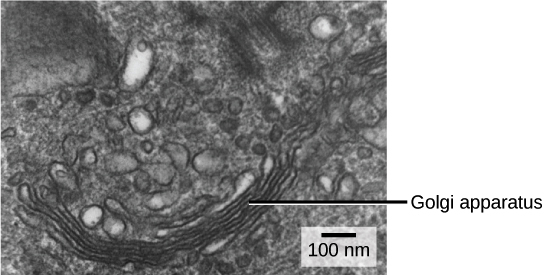
The receiving side of the Golgi apparatus is called the cis face and the opposite side is called the trans face. Transport vesicles from the ER travel to the cis face, fuse with it, and empty their contents into the lumen of the Golgi apparatus.
As proteins and lipids travel through the Golgi, they undergo further modifications. Short chains of sugar molecules might be added or removed, or phosphate groups attached as tags. Carbohydrate processing is shown in the diagram as the gain and loss of branches on the purple carbohydrate group attached to the protein.
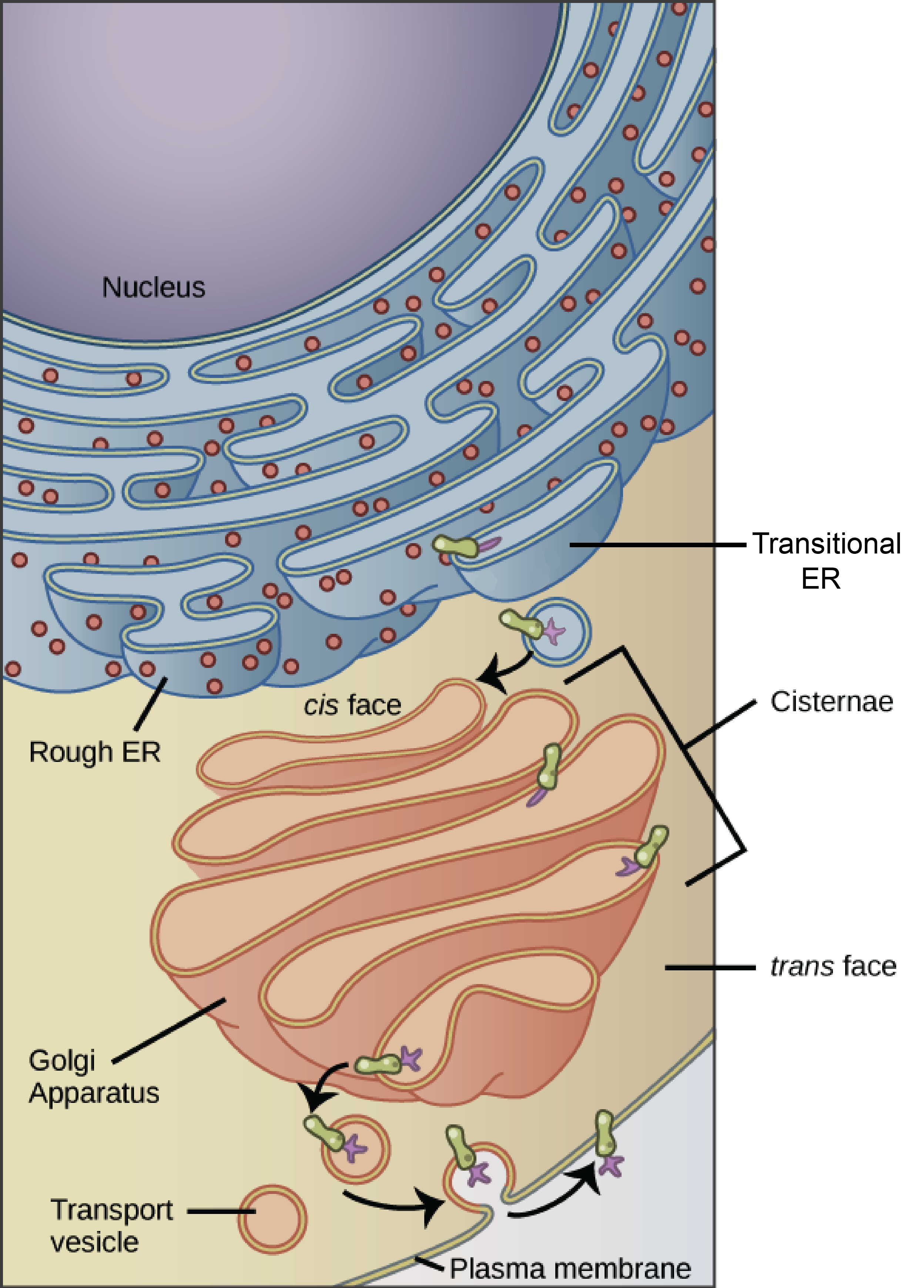
Finally, the modified proteins are sorted (based on markers such as amino acid sequences and chemical tags) and packaged into vesicles that bud from the trans face of the Golgi. Some of these vesicles deliver their contents to other parts of the cell where they will be used, such as the lysosome or vacuole. Others fuse with the plasma membrane, delivering membrane-anchored proteins that function there and releasing secreted proteins outside the cell.
Cells that secrete many proteins—such as salivary gland cells that secrete digestive enzymes, or cells of the immune system that secrete antibodies—have many Golgi stacks. In plant cells, the Golgi apparatus also makes polysaccharides (long-chain carbohydrates), some of which are incorporated into the cell wall.