Omega fatty acids are a class of fatty acids. They are a type of lipid and include the omega-3 and omega-6 fatty acids. There are different types of omega-3 and omega-6 fatty acids, but all of them are made from two basic precursor forms: alpha-linolenic acid (ALA) for omega-3s and linoleic acid (LA) for omega-6s.
The human body needs these molecules (and their derivatives), but can’t synthesize either ALA or LA itself. Accordingly, ALA and LA are classified as essential fatty acids and must be obtained from a person’s diet. Some fish, such as salmon, and some seeds, such as chia and flax, are good sources of omega-3 fatty acids.
Omega-3 and omega-6 fatty acids have at least two cis-unsaturated bonds, which gives them a curved shape. ALA, shown below, is quite bent but isn’t the most extreme example – DHA, an omega-3 fatty acid made from ALA by the formation of additional double bonds, has six cis-unsaturated bonds and is curled up almost in a circle!
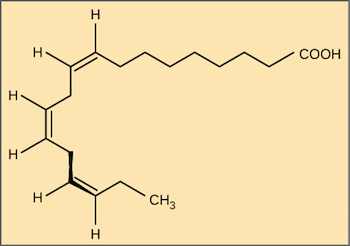
Omega-3 and omega-6 fatty acids play a number of different roles in the body. They are precursors (starting material) for the synthesis of a number of important signaling molecules, including ones that regulate inflammation and mood. Omega-3 fatty acids in particular may reduce the risk of sudden death from heart attacks, decrease triglycerides in the blood, lower blood pressure, and prevent the formation of blood clots.