Introduction
Carbohydrates are biological molecules made of carbon, hydrogen, and oxygen in a ratio of roughly one carbon atom () to one water molecule (). This composition gives carbohydrates their name: they are made up of carbon (carbo-) plus water (-hydrate). Carbohydrate chains come in different lengths, and biologically important carbohydrates belong to three categories: monosaccharides, disaccharides, and polysaccharides.
Monosaccharides
Monosaccharides (mono- = “one”; sacchar- = “sugar”) are simple sugars, the most common of which is glucose. Monosaccharides have a formula of , and they typically contain three to seven carbon atoms.
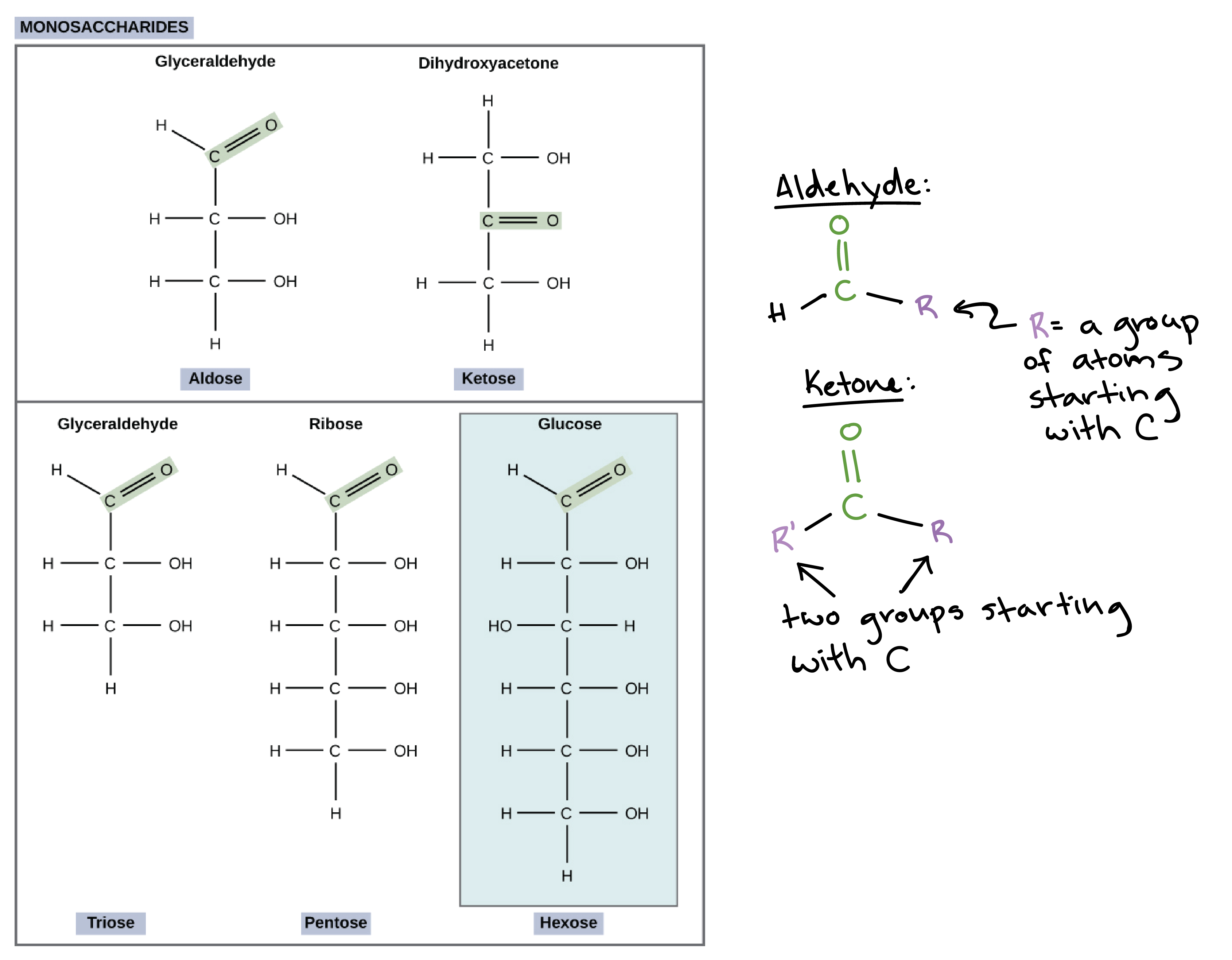
Most of the oxygen atoms in monosaccharides are found in hydroxyl () groups, but one of them is part of a carbonyl () group. The position of the carbonyl () group can be used to categorize the sugars:
- If the sugar has an aldehyde group, meaning that the carbonyl C is the last one in the chain, it is known as an aldose.
- If the carbonyl C is internal to the chain, so that there are other carbons on both sides of it, it forms a ketone group and the sugar is called a ketose.
Sugars are also named according to their number of carbons: some of the most common types are trioses (three carbons), pentoses (five carbons), and hexoses (six carbons).
Glucose and its isomers
One important monosaccharide is glucose, a six-carbon sugar with the formula . Other common monosaccharides include galactose (which forms part of lactose, the sugar found in milk) and fructose (found in fruit).
Glucose, galactose, and fructose have the same chemical formula (), but they differ in the organization of their atoms, making them isomers of one another. Fructose is a structural isomer of glucose and galactose, meaning that its atoms are actually bonded together in a different order.
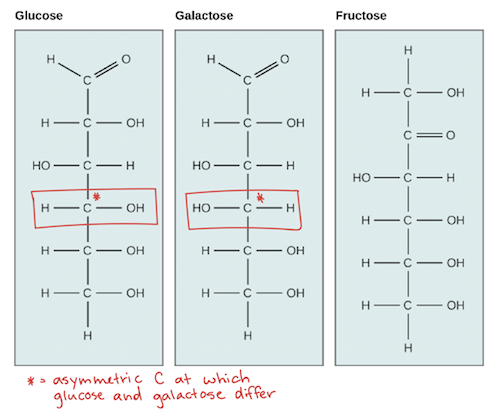
Glucose and galactose are stereoisomers of each other: their atoms are bonded together in the same order, but they have a different 3D organization of atoms around one of their asymmetric carbons. You can see this in the diagram as a switch in the orientation of the hydroxyl () group, marked in red. This small difference is enough for enzymes to tell glucose and galactose apart, picking just one of the sugars to take part in chemical reactions.
Ring Forms of Sugars
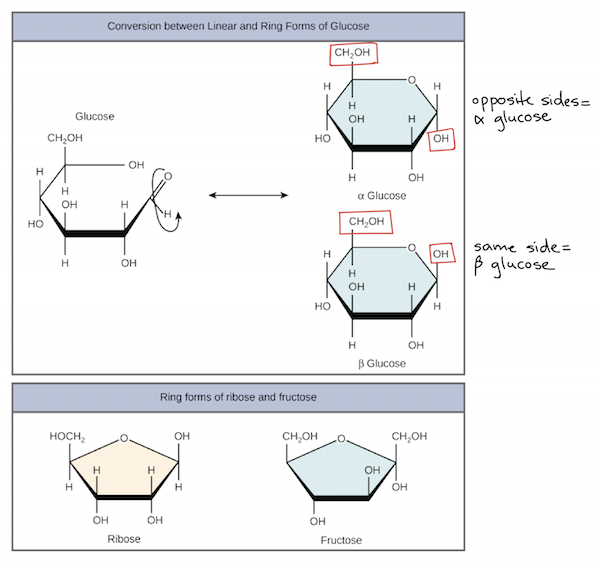
Many five- and six-carbon sugars can exist either as a linear chain or in one or more ring-shaped forms. These forms exist in equilibrium with each other, but equilibrium strongly favors the ring forms (particularly in aqueous, or water-based, solution). For instance, in solution, glucose’s main configuration is a six-membered ring. Over 99% of glucose is typically found in this form.
Even when glucose is in a six-membered ring, it can occur in two different forms with different properties. During ring formation, the from the carbonyl, which is converted to a hydroxyl group, will be trapped either “above” the ring (on the same side as the group) or “below” the ring (on the opposite side from this group). When the hydroxyl is down, glucose is said to be in its alpha (α) form, and when it’s up, glucose is said to be in its beta (β) form.
Disaccharides
Disaccharides (di- = “two”) form when two monosaccharides join together via dehydration synthesis. In this process, the hydroxyl group of one monosaccharide combines with the hydrogen of another, releasing a molecule of water and forming a covalent bond known as a glycosidic linkage.
For instance, the diagram below shows glucose and fructose monomers combining via a dehydration reaction to form sucrose, a disaccharide we know as table sugar. (The reaction also releases a water molecule, not pictured.)
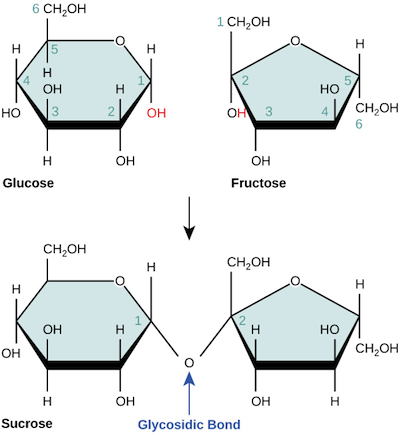
In some cases, it’s important to know which carbons on the two sugar rings are connected by a glycosidic bond. Each carbon atom in a monosaccharide is given a number, starting with the terminal carbon closest to the carbonyl group (when the sugar is in its linear form). This numbering is shown for glucose and fructose, above. In a sucrose molecule, the carbon of glucose is connected to the carbon of fructose, so this bond is called a - glycosidic linkage.
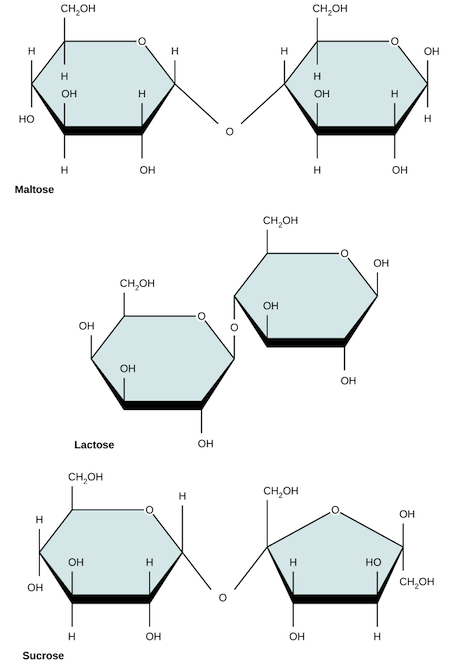
Common disaccharides include lactose, maltose, and sucrose. Lactose is a disaccharide consisting of glucose and galactose and is found naturally in milk. Many people can’t digest lactose as adults, resulting in lactose intolerance (which you or your friends may be all too familiar with). Maltose, or malt sugar, is a disaccharide made up of two glucose molecules. The most common disaccharide is sucrose (table sugar), which is made of glucose and fructose.
Polysaccharides
A long chain of monosaccharides linked by glycosidic bonds is known as a polysaccharide (poly- = “many”). The chain may be branched or unbranched and may contain different types of monosaccharides. The molecular weight of a polysaccharide can be quite high, reaching 100,000 Daltons or more if enough monomers are joined. Starch, glycogen, cellulose, and chitin are some major examples of polysaccharides important in living organisms.
Storage Polysaccharides
Starch is the stored form of sugars in plants and is made up of a mixture of two polysaccharides, amylose and amylopectin (both polymers of glucose). Plants are able to synthesize glucose using light energy gathered in photosynthesis, and the excess glucose, beyond the plant’s immediate energy needs, is stored as starch in different plant parts, including roots and seeds. The starch in the seeds provides food for the embryo as it germinates and can also serve as a food source for humans and animals, who will break it down into glucose monomers using digestive enzymes.
Structural Polysaccharides
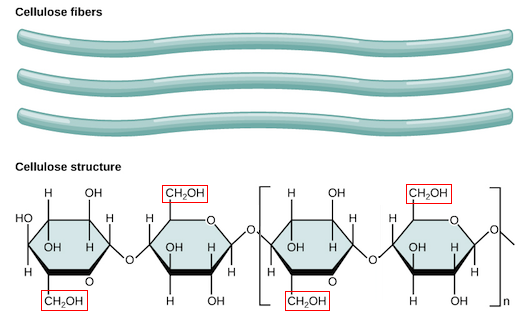
Although energy storage is one important role for polysaccharides, they are also crucial for another purpose: providing structure. Cellulose, for example, is a major component of plant cell walls, which are rigid structures that enclose the cells (and help make lettuce and other veggies crunchy). Wood and paper are mostly made of cellulose, and cellulose itself is made up of unbranched chains of glucose monomers linked by - glycosidic bonds.