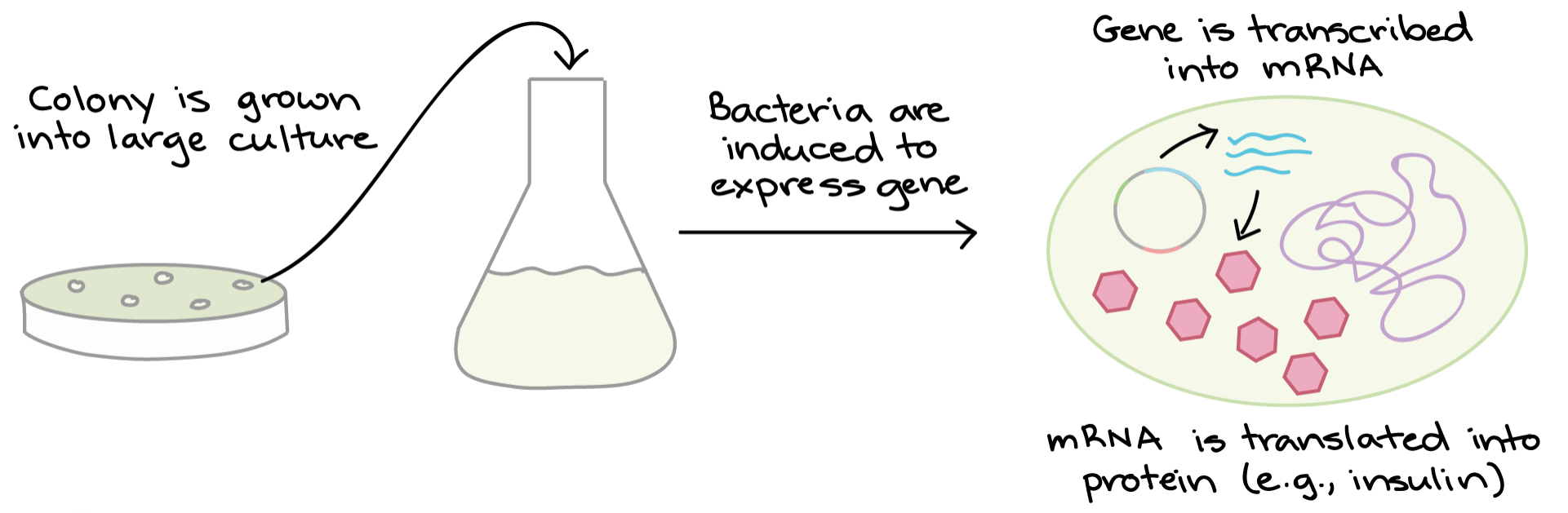
Once we have found a bacterial with the right plasmid, we can grow a large culture of plasmid-bearing bacteria. Then, we give the bacteria a chemical signal that instructs them to make a target protein.
The bacteria serves as miniature “factories,” churning out large amounts of proteins. For instance, if our plasmid contained the human insulin gene, the bacteria would start transcribing the gene and translating the mRNA to produce man molecules of human insulin protein.
Once the protein has been produced, the bacterial cells can be split open to release it. There are many other proteins and macromolecules floating around in bacteria besides the target protein (e.g., insulin). Because of this, the garget protein must be purified, or separated from the other contents of the cells by biochemical techniques. The purified protein can be used for experiment or, in the case of insulin, administered to patients.