Introduction Meiosis is used for the production of gametes. Meiosis produces daughter cells with exactly half the chromosomes as the starting cell.
Meiosis takes diploid cells and produces haploid cells, sperm and egg cells. When a sperm and an egg join in fertilization, the two haploids sets of chromosomes form a diploid set: a new genome.
Phases of Meiosis The cell goes through similar stages of mitosis. However, it needs to separate sister chromatids, as in mitosis. But it must also separate homologous chromosomes, the similar but nonidentical pairs an organism receives for its two parents.
The goals of meiosis uses a two-step division process. Homologue pairs separate during the first round of cell division, called meiosis I. Sister chromatids separate during a second round, called meiosis II.
Meiosis I During prophase I, differences from mitosis begin to appear. Like mitosis, the chromosomes begin to condense, but in meiosis I, they also pair up. Each chromosome aligns with its homologue partner so that the two match up at corresponding positions along their full length.
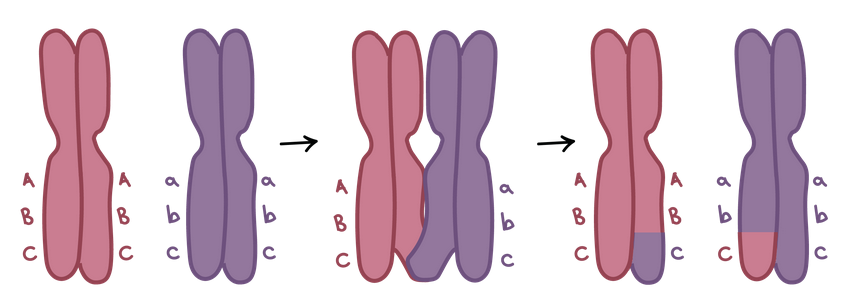
In a process known as crossing-over, DNA is broken and reconnected in a crisscross pattern so that the homologues exchange part of their DNA. It’s helped along by a protein structure called the synaptonemal complex that holds the homologues together. The chromosomes would actually be positioned one on top of the other during the process of crossing-over.
You can see crossovers under a microscope as chiasmata, cross-shaped structures where homologues are linked together. Chiasmata keep the homologues connected to each other after the synaptonemal complex breaks down, so each homologues pair needs at least one.
The spots where crossovers happen are more or less random, leading to the formation of unique chromosomes with unique combinations of alleles.
After crossing over, the spindle begins to capture chromosomes and move them towards the center (metaphase plate). So during metaphase I, homologue pairs line up at the metaphase plat for separation.
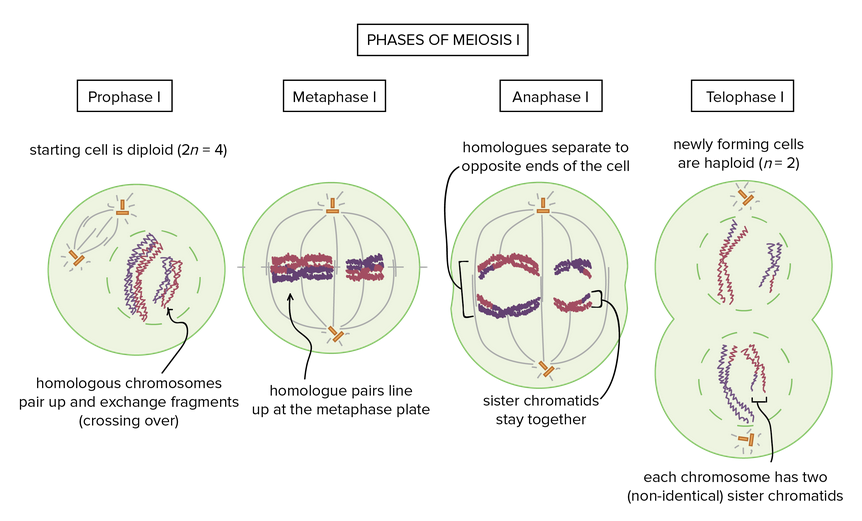
In anaphase I, the homologues are pulled apart and move apart to opposite ends of the cell. The sister chromatids, of each chromosome, however, remain attached to one another and don’t come apart.
Finally, in telophase I, the chromosomes arrive at opposite poles of the cell. In some organisms, the nuclear membrane re-forms and the chromosomes decondense, although in others, this step is skipped since cells will go into meiosis II. Cytokinesis usually occurs at the same time as telophase I, forming two haploid daughter cells.
Meiosis II Cells move from meiosis I to meiosis II without copying their DNA. Meiosis II is a shorter and simpler process than meiosis I. You can remember meiosis II as “mitosis for haploid cells.”
The cells that enter meiosis II are the ones made in meiosis I. These cells are haploid but their chromosomes still consist of two sister chromatids. In meiosis II, the sister chromatids separate, making haploid cells with non-duplicated chromosomes
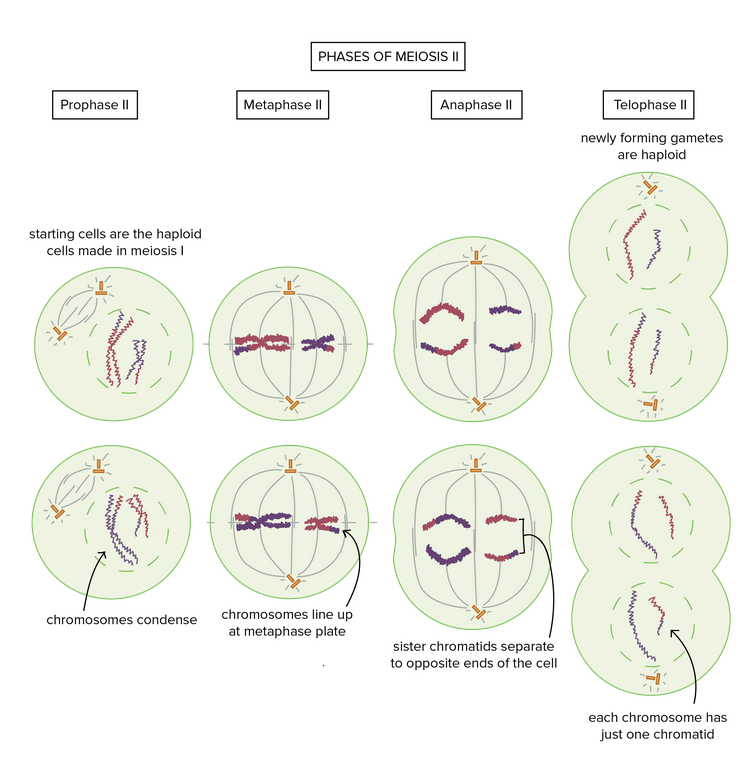
During prophase II, chromosomes condense and the nuclear envelope breaks down, if needed. The centrosomes move apart, the spindle forms between them, and the spindle microtubes begin to capture chromosomes.
In metaphase II, the chromosomes line up individually along the metaphase plate.
In anaphase II, the sister chromatids separate and are pulled towards opposite poles of the cell.
In telophase II, nuclear membranes form around each set of chromosomes, and the chromosomes decondense. Cytokinesis splits the chromosome sets into new cells, forming the final products of meiosis: four haploid cells in which each chromosome has just one chromatid. In humans, the products of meiosis are sperm or egg cells.