The lysosome is an organelle that contains digestive enzymes and acts as the organelle-recycling facility of an animal cell. It breaks down old and unnecessary structures so their molecules can be reused. Lysosomes are part of the endomembrane system, and some vesicles that leave the Golgi are bound for the lysosome.
Lysosomes can also digest foreign particles that are brought into the cell from outside. As an example, let’s consider a class of white blood cells called macrophages, which are part of the human immune system. In a process known as phagocytosis, a section of the macrophage’s plasma membrane invaginates—folds inward—to engulf a pathogen, as shown below.
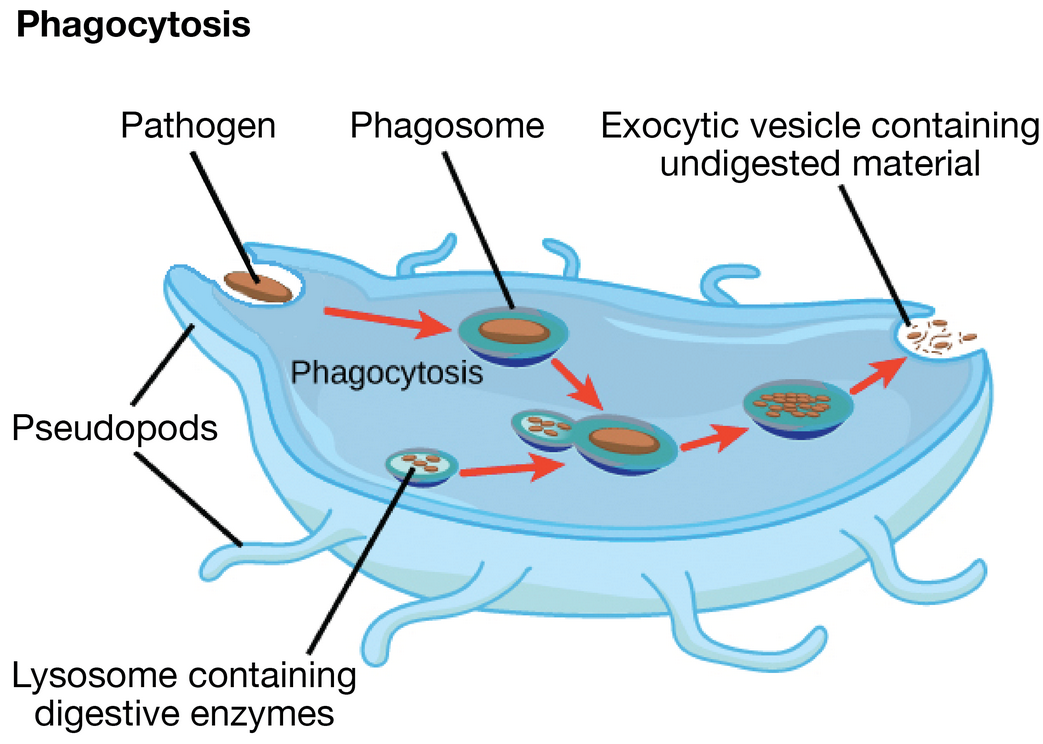
The invaginated section, with the pathogen inside, pinches off from the plasma membrane to form a structure called a phagosome. The phagosome then fuses with a lysosome, forming a combined compartment where digestive enzymes destroy the pathogen.