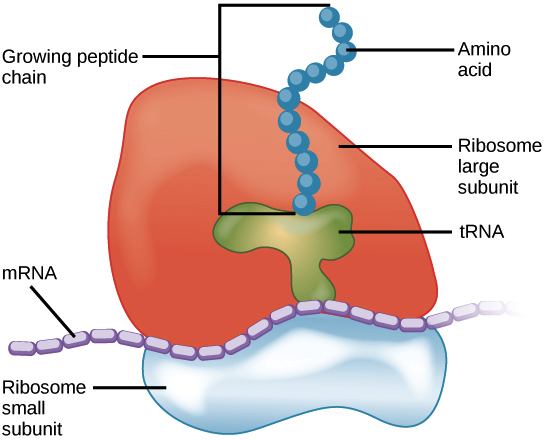
Ribosomes are macromolecular machines, found within all cells, that perform biological protein synthesis. A ribosome is made out of RNA and proteins, and each ribosome consists of two separate RNA-protein complexes, known as the small and large subunits. The large subunit sits on top of the small subunit, with an RNA template sandwiched between the two
In eukaryotes, ribosomes get their orders for protein synthesis from the nucleus, where portions of DNA (genes) are transcribed to make messenger RNAs (mRNAs). An mRNA travels to the ribosome, which uses the information it contains to build a protein with a specific amino acid sequence. This process is called translation. Prokaryotes lack a nucleus, so their mRNAs are transcribed in the cytoplasm and can be translated by ribosomes immediately.
Eukaryotic ribosomes may be either free, meaning that they are floating around in the cytoplasm, or bound, meaning that they are attached to the endoplasmic reticulum or the outside of the nuclear envelope. (In the first diagram in this article, the red dots represent bound ribosomes; endoplasmic reticulum with bound ribosomes is known as rough endoplasmic reticulum.)
Because protein synthesis is an essential function of all cells, ribosomes are found in practically every cell type of multicellular organisms, as well as in prokaryotes such as bacteria. However, eukaryotic cells that specialize in producing proteins have particularly large numbers of ribosomes. For example, the pancreas is responsible for producing and secreting large amounts of digestive enzymes, so the pancreatic cells that make these enzymes have an unusually high number of ribosomes.