What are Linear Relationships?
A linear relationship is any relationship between two variables that creates a line when graphed in the -plane.
Linear Relationships
Linear equations can be used to represent the relationship between two variables, most commonly and . To form the simplest linear relationship, we can make our two variables equal:
By plugging numbers into the equation, we can find some relative values of and .
| 0 | 0 |
| 1 | 1 |
| 2 | 2 |
| 3 | 3 |
| If we plot these points in the -graph, we create a line. |
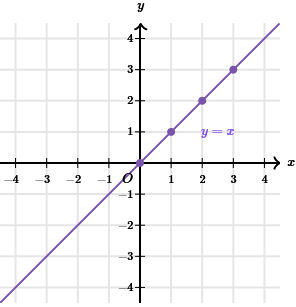
Every possible linear relationship is just a modification of this simple equation. We might multiply one of the variables by a coefficient or add a constant to one side of the equation, but we’ll still be creating a linear relationship.
How do we translate word problems into linear equations?
Modeling Real World Scenarios
Translating Word Problems
It may not be hard to translate “Maya is inches taller than Geoff” into a linear equation, but some SAT word problems are several sentences long, and the information we need to build an equation may be scattered around.
Examples
A car with a price of is to be purchased with an initial payment of and monthly payments of . Which of the following equations can be used to find the number of monthly payments, , requires to complete the purchase, assuming there are no taxes or fees.
Translation:
We're given three important values here: 17,000, 5,000, and 240.
- $17,000 is the total price, so that's what everything else needs to add up to.
- $5,000 is a one-time payment.
- $24 is a constant amount that's paid every month, so it needs to be multipled by m, the number of months.
The total price, $17,000, euqals the sum of the other payments: the inital $5,000 payment and the $240 paid each month (m).
17,000 = 5,000 + 240mWhat will we be asked to do in linear equations word problems?
On the test, we may be asked to:
- Write our own equation based on the word problem
- Write our own equation and then solve it
- Solve a given equation based on the word problem
Example
A helicopter, initially hovering feet above the ground, begins to ascend at a speed of feet per second. Write an equation that can be used to find , the number of seconds it takes for the helicopter to reach feet above the ground.
The total height, which everything else must add up to, is feet.
The starting height of the helicopter is feet.
The amount of time it takes is seconds.
We can write the equation as
Linear Functions
Any linear equation with two variables is technically a function. Linear functions are usually written in either slope-intercept form or standard form. We need a thorough and flexible understanding of these forms in order to approach many SAT questions about linear relationships.
Slope-intercept Form
The slope-intercept form of a linear function, , where and are constants, tells us both the slope and the -intercept of the line:
- The slope is equal to .
- The -intercept is equal to .
Standard Form
The standard form of a linear function, , where, , , and are constants, will always be used in word problem scenarios that have two outputs, instead of an input and an output. To find the slope or -intercept of a line in standard form, it’s often convenient to convert the equation to slope-intercept form by isolating .
What will we be asked to do in linear function word problems?
On the test, we may be asked to:
- Write our own linear function based on the word problem (We may need to calculate the slope or -intercept in more challenging questions.)
- Identify the meaning of a value in a given function that models a scenario
Things to Remember
The slope-intercept form of a linear equation, , tells us both the slope and the -intercept of the line:
- The slope is equal to .
- The -intercept is equal to .
We can write the equation of a line as long as we know either of the following:
- The slope of the line and a point on the line
- Two points on the line